
Like I said in yesterday’s Update post, I will not be posting anything in the immediate wake of Update posts anytime soon. I am still going to be working on the rest of the Entries for Work-Standard Accounting Practices, but… Read More ›
Accounting
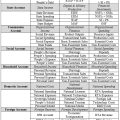
Revising the Accounting Table
Two years ago, the last Section of The Work-Standard (2nd Ed.) included an accounting table that could serve as the Work-Standard’s equivalent to the System of National Accounts (SNA). That accounting table proved to be too disorganized and ill-suited for… Read More ›

Work-Standard Accounting Practices: Financial Indicators of Profit and Utility Maximization
Are there any corresponding financial indicators related to Production for Profit and Production for Utility? If so, are there two separate sets, one for individual economic organizations and another for Parliament? Back in the previous Entry, we discussed the System… Read More ›
Plans on Finishing “Work-Standard Accounting Practices”
As it stands, I am nearly done with Work-Standard Accounting Practices (1st Ed.). There are four Entries in Section One that remains incomplete, while I have yet to determine how many Entries should be devoted to Section Three. For Section… Read More ›
Fundamentals of Command-Obedience Account Bookkeeping (Pt. II of III)
With the TPP Account uncovered, the next step is to find the LER Account, which is represented by the sum of RTEP (Real Total Economic Potential) and RTFP (Real Total Financial Potential). RTEP is TEP (Total Economic Potential) and RTEP… Read More ›

Postmodernity and Rise of Social Communions
Yesterday’s latest Entry of Work-Standard Accounting Practices, “Managerial Cost Accounting,” showcased two accounting methods associated with Eugen Schmalenbach. Schmalenbach was a well-known German economist within German academia who is unknown nowadays, even though his contributions to accounting had gone on… Read More ›
Work-Standard Accounting Practices: Managerial Cost Accounting
Many of the economic and financial indicators that Neoliberalism still employs in the early 21st century were developed throughout the early 20th century. The Great Depression and two World Wars, of which the Cold War was the extension of the… Read More ›
Work-Standard Account Practices: Marxist Critiques of Double-Entry Account Bookkeeping
Compared to the previous two Entries that focused on Environmentalism and Feminism, Marxist Theory posited its own criticisms of Double-Entry Account Bookkeeping that differed from the other two ideologies. While Environmentalism is divided over Kapital and Feminism has somewhat conformed… Read More ›
Work-Standard Accounting Practices: Triple-Entry Account Bookkeeping
The emergence of Cryptocurrencies, beginning with Bitcoin, has made it feasible to entertain the development of Triple-Entry Account Bookkeeping as an expansion of Double-Entry Account Bookkeeping. Conceptually speaking, Triple-Entry Account Bookkeeping follows very similar premises to that of Double-Entry Account… Read More ›
Work-Standard Accounting Practices: Fundamentals of Command-Obedience Account Bookkeeping (Pt. I of III)
“Command-Obedience Account Bookkeeping” refers to the reapplication of the Work-Standard’s Intents of Command and Obedience to the Accounting Profession. Its purpose is to develop a reliable alternative to the Double-Entry Account Bookkeeping System, capable of acquiring financial data on the… Read More ›
 The Fourth Estate
You must be logged in to post a comment.