

The Death of Bretton Woods, among other things, contributed to Great Britain’s adoption of Decimalization for its Pound Sterling (GBP). Today, the British rely on Decimalization like most of the Western world. It works the same in the US Dollar and the Euro, absent any differences in their overall valuation.
1 Pence (p) or penny is the basic unit of currency for the Pound Sterling. 100p is equal to 1 Pound (£). The denominations of Pence represent six coins, complemented by two Pound coins:
- 1p
- 2p
- 5p
- 10p
- 20p
- 50p
- £1
- £2
There are only four banknotes in the Pound Sterling:
- £5
- £10
- £20
- £50
This may seem straightforward, but the British have historically been a latecomer to Decimalization. While most of the Western world had adopted Decimalization to facilitate international trade and greater ease of convenience in determining the Values of different currencies, the British chose to retain their archaic currency measurement system for as long as Kapital continued to be backed by Gold and Silver. Arguably, their system’s existence in the Western world coincided with the hegemony of the British Empire over the past two centuries, becoming considered obsolete as the British Empire underwent its eventual decline and downfall.
The Pre-Decimal Currency System presupposes that the Pound Sterling comprised mostly of minted coins. Banknotes did exist in Britain as far back as the founding of the Bank of England, but they were not commonplace as privatized commercial banks prior to the 20th century tended to print their own banknotes. Thus, while a piece of Silver could be worth a pound, it can be cut into smaller increments at a fraction of its Value. These increments were what led to the peculiar denominations of the Pre-Decimal Currency System. The Farthing is the smallest unit, followed by the Half-Penny and the Penny, the Three-Penny and the Sixpence, the Shilling and the Florin, the Crown and the Pound.
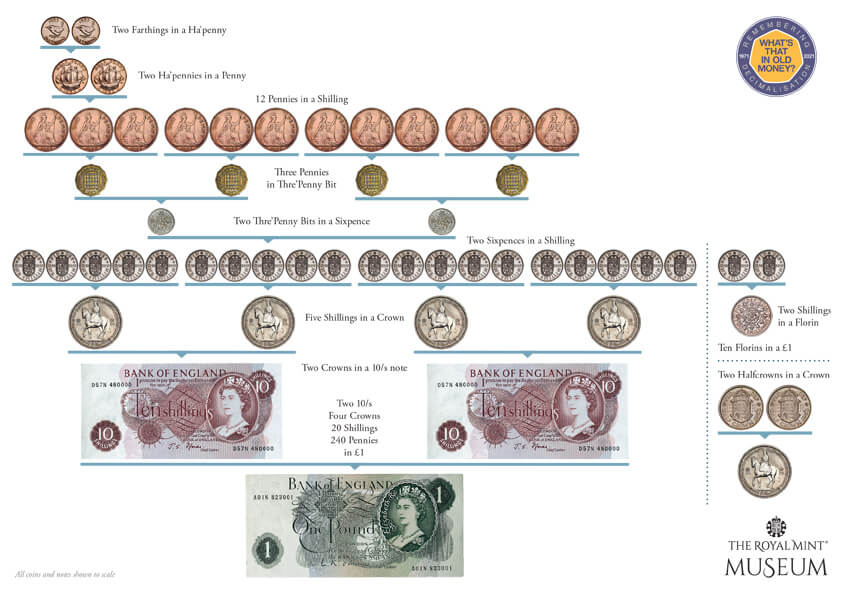
Looking back at it with historical hindsight, one becomes astounded by the complexity if they have been accustomed to decimalized coins and banknotes. Unless somebody grew up in 20th century Britain prior to Decimalization, it can sometimes be challenging to instinctively reapply it with another currency, including those Sociable Currencies backed by the Work-Standard.
How did the Pre-Decimal Currency System function in practice? The simplest solution was to organize it as “£sd”—”Pounds, Shillings, and Pence.” The basic premise was that:
240p = 1£
Every 240 Pence was equal to 1 Pound. A Pound was also equal to 20 Shillings, each Shilling worth 12 Pennies. Every Penny could then be divided further into 2 Half-Pennies or 4 Farthings. In the end, all of the other values are equal to 1 Pound:
960 Farthings = 480 Half-Pennies = 240 Pence = 20 Shilling = 1 Pound
As stated earlier, it can be easy to find the Pre-Decimal Currency System to be too archaic for anyone accustomed to decimalized currency system. Consider the manner in which a transactional sale was supposed to be formatted:
£1 20s 240d
The above statement is 1 Pound, 20 Shillings, and 240 Pence. Both the Shillings and the Pence are equal to 1 Pound. With the Pound being backed by Gold and Silver, it was probably mundane for the British at one point to be relying more on the Shillings and Pence within their transactional sales. It is hard to imagine them with Pounds back when the Pound Sterling was backed by the Gold Standard. Obviously, the Death of Bretton Woods has changed that, making Decriminalization a necessity that younger generations in Britain take for granted.
Categories: Economic History
 The Fourth Estate
Leave a comment