
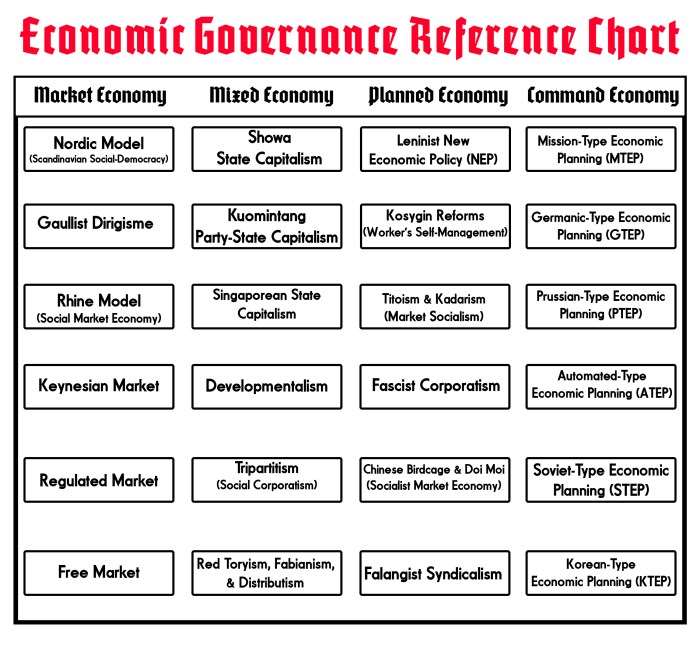
There are only four types of Economic Governance under the Work-Standard, two of which belong to Neoliberalism: “Market Economy,” “Mixed Economy,” “Planned Economy,” and “Command Economy.” As established in the preceding Entry, only the Planned Economy and Command Economy are compatible with the Work-Standard. Neoliberalism has the “Market/Mixed Economy” and the VCS Economy has the “Planned/Command Economy.” For the purposes of this Entry and the Treatise overall, the VCS Economy is capable of configured to be Artistic or Scientific Socialist, Corporatist, Syndicalist and State Capitalist. Artistic and Scientific Socialist VCS Economies tend to be Command Economies or high-tier Planned Economies. Corporatist and Syndicalist VCS Economies comprise the mid-tier Planned Economies, with State Capitalist VCS Economies being mid-tier or low-tier Planned Economies. We deduce the distinguishing traits of VCS Economies as Planned/Command Economies based on the configurations of those five.
Planned/Command Economies
“Command Economies” feature hierarchical, well-delineated, well-organized hierarchical Social Ranking Systems where all Economic Organizations are governed by the Economic Chambers as part of a functioning Council Democracy. Most Enterprises within the VCS Economy are split between State Enterprises and Social Enterprises, where the Council State wields the Intents of Command and Obedience at the behest of a Federalist or Unitary nation. Some Enterprises are directly overseen by the Council States, some by Regional and Municipal governments, and others by various elements of the Totality. A Council State relies on a central plan whose interpretation is defined by the Central Planners and whose execution is carried out by the Professions and Enterprises that comprise the Industries of the VCS Economy’s Economic Sectors. Special institutions will also be present to determine Wages and Prices as well as facilitate the investments of Arbeit and Geld, both of which require the Totality’s political participation.
“Planned Economies” are less hierarchical and more likely to be employed in Federalist or Confederal nations relying on Council Democracy. While the Council State still wields the Intents of Command and Obedience and still maintains those special institutions, there is a larger proportion of Social Enterprises than State Enterprises. There may be a large non-government organization presiding over multiple labor unions. Instead of a single central plan, there are multiple central plans whose interpretations and executions are conducted by different Industries within each Economic Sector. In Corporatism, Syndicalism and State Capitalism, the configurations of the VCS Economy may be altered whilst remaining under the Work-Standard.
In Corporatist VCS Economies, economic life is maintained by the “Corporate State” acting as an intermediary between “Organized Labor” and the “Business Community.” The powers of Organized Labor and Business Community are checked by the Corporate State, just as the powers of the Corporate State are supposed to be balanced by Organized Labor and the Business Community. The Self is encouraged to collaborate with the Corporate State to resolve the differences between Organized Labor and the Business Community in the pursuit of Solidarity, ensuring no one branch of the Corporatist VCS Economy overpowers the other two branches.
In Syndicalist VCS Economies, the Enterprises of the “Syndicalist State” are all Syndicates owned, controlled and operated by labor unions. Since political parties, people’s communities, religious congregations and even university students are equally capable of starting labor unions, it becomes inevitable to envisage entire Industries to be controlled by different groups. A Syndicalist State presides over the VCS Economy with “Trade Federations” in charge of each Economic Sector. Every Trade Federation is comprised of various Syndicates whose Delegates were selected from Delegates chosen by the personnel of each Enterprise. The Syndicates in particular are what makes a Syndicalist VCS Economy best-suited for Confederal nations as opposed to Federalist or Unitary nations.
In State Capitalist VCS Economies, each Economic Sector is dominated by a small number of very large Enterprises in charge of their respective Industries. The “Commercial State” has the Enterprise of its nation’s most strategically vital Industries as State Enterprises. All Social Enterprises operate as Cartels and Associations beholden to the Council Democratic process. The same special institutions that can be found in Corporatist and Socialist VCS Economies are also present because the Commercial State wields the Intents of Command and Obedience. But because all labor unions operate under the oversight of these Cartels and Associations, all Cartels and Associations must work directly with labor unions through Council Democratic process to determine the Wages and Prices of the Totality.
Market/Mixed Economies
Granted, not all State Capitalist, Syndicalist and Corporatist economies are guaranteed to be Planned Economies. Some can become “Mixed Economies” if they are not backed by the Work-Standard and there is enough Economic Liberalization from Neoliberalism. A Syndicalist economy may not be stable enough to ensure that it will not immediately or gradually downgrade itself into a Mixed Economy. A Corporatist economy may supplant Organized Labor with a Fractional-Reserve Banking System of privatized commercial banks and Financial Markets.
Certain Planned Economies, such as the “Chinese Socialist Market Economy” or the “Vietnamese Doi Moi Economy,” are considered low-tier for having been the products of Economic Liberalization in the late 20th century. What keeps them from being Mixed Economies is due to the fact that their practical applications resulted in the creations of two economies within the actual national economy. One economy consists of State and Social Enterprises under the Intents of Command and Obedience, whereas the other economy is comprised of Foreign and Private Enterprises under the Incentives of Supply and Demand.
It is because of those considerations that most “Mixed Economies” tend to be Parliamentary Democracies where the Parliament has strategic economic activities like crude oil and petroleum, rare minerals, armaments, transportation, healthcare or power plants as “Public Utilities.” The rest of its economy is dominated by Private Enterprises and Foreign Enterprises that compete for the greatest Quantity of Kapital with the least Quantity of Schuld in a Market. The Market, instead of those special institutions, decides the Wages and Prices without the Totality’s input. Private Enterprises and Foreign Enterprises constitute the “Private Sector,” coexisting with the “Public Sector” that is in charge of providing all “Public Utilities.”
“Market Economies,” despite being run by Parliamentary Democracies and being similar to Mixed Economies, are distinguished by giving greater emphasis to the Private Sector in charge of the Market. Instead of a well-balanced delineation between the Public and Private Sectors, the Parliament will employ “Public-Private Partnerships (P3s)” and “Corporate Trusts” to oversee the provision of Public Utilities. P3s and Corporate Trusts in Market Economies are devised in circumstances where neither Privatization nor Nationalization is practical. Since the Private Sector is motivated by the greatest Quantity of Kapital for the Quantity of Schuld, the Public Sector relies on the issuances of government contractors, non-profit organizations, philanthropies and charities to support its everyday operations.
Brief History of Economic Planning
It is notable that one of the peculiar features exhibited by the Work-Standard is its own distinct conception of economic planning for all VCS Mixed/Command Economies. This is interesting because most Planned/Command Economies in the previous century have been geared toward two specific variants: the crude, rudimentary STEP (Soviet-Type Economic Planning) of the Soviet Union, Eastern Bloc and Maoist China; and the slightly more refined PTEP (Prussian-Type Economic Planning) devised by the Prussians of the German Reich.
PTEP in particular was developed in response to the harsh wartime conditions of World War I. A little-known attempt was made to continue PTEP for peacetime purposes after 1918 but was never realized due to the Liberal Capitalist establishment of the Weimar Republic. This of course was the largely obscure economic proposals outlined by Wichard von Moellendorff and his attempts to preserve PTEP in the interwar chaos of 1918-1919. While Oswald Spengler’s Preußentum und Sozialismus (Prussianism and Socialism) remains a timeless advocacy for the coalescence between the Prussian instinct and Socialism, von Moellendorff’s proposals had been a flawed attempt to realize Prussian Socialism in actual practice.

The purpose of PTEP, had it been implemented, would have entailed the creation of a new legal jurisprudence and political governance designed to realize the transitional phase to a Command Economy. There would be attempts made at trying to realize the kind of Council Democracy outlined by Freiherr vom Stein as well as build upon the ideas articulated by Johann Gottlieb Fichte and attempted by Otto von Bismarck. What arguably prevented von Moellendorff’s proposals for PTEP from being realized, besides an apparent unwillingness to accept the slightest constructive criticism from close political allies, are flaws which can also be found in STEP. In essence, the lack of reliable financial and monetary models to replace existing Liberal Capitalist ones, an absence of institutions for resolving economic disputes among workers and among industries, and an overreliance on technology to overcome the shortcomings of human nature. All of these factors are indicative as to why the proposals found little support from sympathetic German businessmen, industrialists and magnates.
As is commonly known, STEP relies on the implementation and coordination of a Command Economy on a Five-Year Plan. Each Five-Year Plan will usually outline the intended aims of the central government, including production quotas, targets, resource allocations, and so forth. The goal is to achieve or exceed the objectives within the given timeframe. Historically, most tend to be conducted and completed in four years. It can be argued that the “Four-Year Plan” of the Hitlerists to remobilize the German armed forces between 1936 and 1940 was a flawed derivative of STEP, devised as a strategic military plan to be completed within four years.
But whereas PTEP had fewer flaws (for what it was worth), STEP was cruder and far more rudimentary in both its applications and its flaws. STEP, in addition to the flaws it shared with PTEP, placed excessive emphasis on the decision-making of central planners to the detriment of the energy, talent, ambition, resolve, and initiative of the workers themselves. The static, inelastic implementation of Five-Year Plans hinders any Command Economy from reacting quickly to changes in economic conditions, as evidenced by the German invasion of the Soviet Union in 1941. Human errors related to discerning the prioritization of certain goods and services can also lead to shortages and even rationing in more extreme, dire circumstances.
Granted, this is not to suggest that there is nothing to learn from the strengths and weaknesses of STEP and PTEP. Both contain ideas which can be retained and others worthy of informing the specifications of the Work-Standard. Any preservation of the techniques from STEP and PTEP needs to be handled with care. The Work-Standard’s conception of economic planning can be summarized as the following:
- The concept of executing a central economic plan, including its targets and quotas, can always be replaced by an elastic Constitution of Intents and Obligations and a conveyable Legal Code of Duties and Rights. There would be no need to have an excessive paper trail that would require massive bureaucracies as these are also the same legal documents governing the nation outside of economic and financial contexts.
- Economic plans themselves can be replaced by equivalent financial instruments that are not LCFIs (Liberal Capitalist Financial Instruments) insofar as they do not rely on the dialectics of lending Credits and borrowing Debits (with or without Interest). They instead rely on the Work-Standard as Socialist Monetary Policy.
- Additionally, the use of Technology can be employed by the Work-Standard as part of a “Mechanization Rate” as a suitable replacement for an Interest Rate. Doing so would entail the Synchronicity (to use a term from Jungian Psychology) between the Figure of the Arbeiter and his technology, as advocated by Ernst Jünger’s philosophical book, Der Arbeiter (The Worker).
- The realization of such financial instruments would require the introduction of special institutions designed as Socialistic alternatives to the need for financial markets. These institutions would have the honor of resolving disputes in the VCS Economy and be responsible for the setting of Wages and Prices with the recommendations of the State and Social Enterprises. In fact, the Council State entrusts these institutions to act on its behalf.
- There will be distinct fiscal and monetary policymaking commensurate with a unique accounting system exclusive to the Work-Standard. The policymaking and accounting system are specifically designed to accommodate the interplay between Arbeit and Geld.
Categories: Compendium
 The Fourth Estate
Leave a comment