
The Work-Standard is designed to accommodate a variety of Scientific and Artistic Socialisms, Corporatism, Syndicalism, and State Capitalism. Practically any national economy that is not operating under Neoliberalism is capable of adopting the Work-Standard. Non-Neoliberal national economies are categorized by the Work-Standard as “Planned/Command Economies,” distinguishing them from the “Market/Mixed Economies” that characterize Neoliberalism. The best example of this trend is exemplified by Corporatism: The Work-Standard is capable of being applied in a State Corporatist economy, a low-tier Planned Economy, but not a Social Corporatist one, a low-tier Mixed Economy. For best results, the Planned/Command Economy in question has to operate as a “Vocational Civil Service (VCS) Economy.” There are five types of Economic Organizations in a basic VCS Economy: “State Administrated Enterprise (SAE),” “State-Owned Enterprise (SOE),” “National-Socialized Enterprise (NSE),” “Public-Owned Enterprise (POE),” and “Public-Directed Enterprise (PDE).”
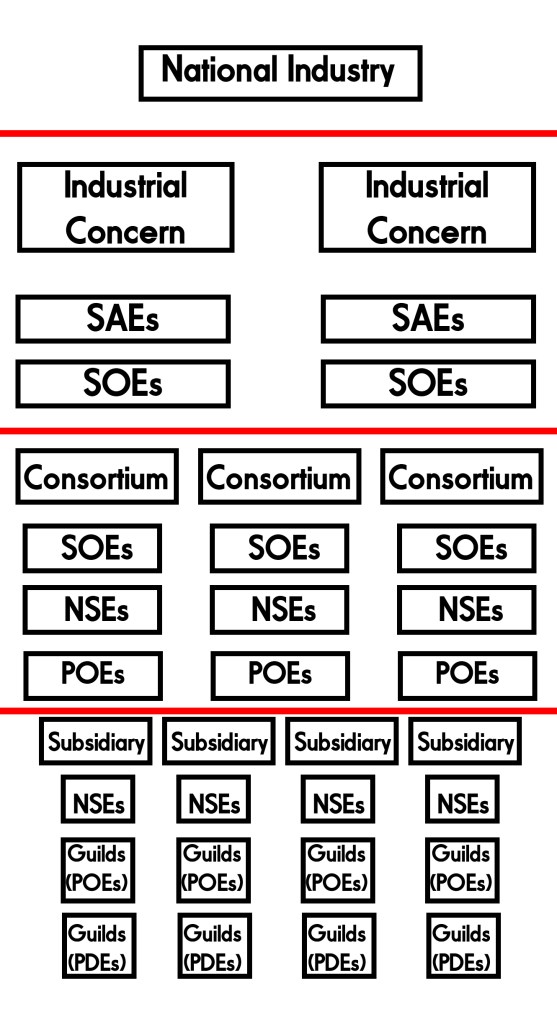
- State-Administrated Enterprises (SAEs) are Enterprises owned and operated by the State. SAEs are recognized by the State as being strategically important to the nation. Thus, they are incapable of operating beyond its borders without being deployed as an official extension of its nation. SAEs tend to very large in terms of size, composition and overall capacity to create Arbeit and Geld. They may operate alone or as part of an “Industrial Concern” consisting of several or more SAEs.
- State-Owned Enterprises (SOEs) are Enterprises that operate on their own initiative whilst under State ownership. Although smaller and less capable than SAEs in terms of Arbeit and Geld, they are still large enough to warrant being brought under the economic governance of the State. Their smaller size and composition also afford them greater flexibility in operating outside of the nation as part of International Trade. SOEs may operate on their own or as part of a “Consortium” with several SOEs, NSEs and POEs.
- National-Socialized Enterprises (NSEs) are Enterprises whose ownership and operation are split between the State and at least one other element of the Totality. As such, they tend to be larger and more powerful than POEs and PDEs due to their flexibility and capacity to create Arbeit and Geld on a nationwide scale. Depending on their size and composition, they can operate alone or as part of a Consortium with various SOEs, other NSEs, and some POEs. Smaller NSEs are more likely to operate alongside POEs and PDEs as the Subsidiary of larger economic organizations.
- Publicly-Owned Enterprises (POEs) are Enterprises owned and operated by the Totality. Smaller and less capable than most NSEs, but larger than the PDEs, the vast majority are designed to be affiliated with a Subsidiary or as part of a community-organized “Guild.” Large POEs work alongside SOEs and NSEs as part of the Subsidiary, whereas the smaller ones belong to the Guilds. Most POEs are likely to be affiliated with Guilds because they will not be capable of having nationwide or worldwide reach, which makes them ideal for being brought under the oversight of Regional and Municipal governments.
- Publicly-Directed Enterprises (PDEs) are small Enterprises that create small amounts of Arbeit and Geld as part of an affiliated Guild of PDEs. The vast majority of PDEs tend to be Small Businesses, Cooperatives, and Workshops, which brings them under the governance of a Municipal government.
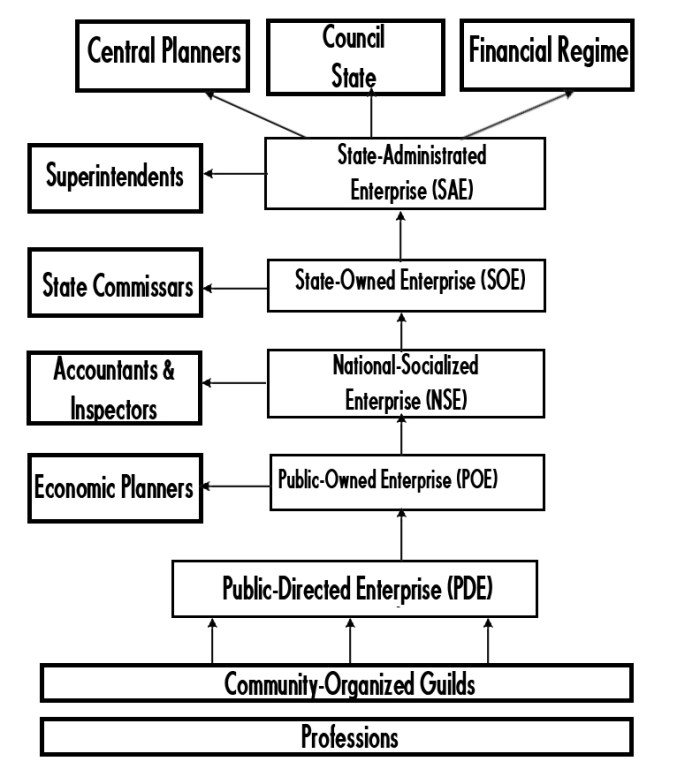
As one could surmise from those five basic Economic Organizations, the amount of Arbeit and Geld that a given Enterprise contributes will determine whether they will be overseen by the Council State, the Regional government, or the Municipal government. This is referred to as the “Social Rank,” which determines whether the Enterprise in question has delegation to an “Economic Chamber” inside the Councils of either the Municipal government, Regional government, or the Council State. In a functioning Council Democracy under the Work-Standard, the political process begins in the workspace, where the personnel of every Enterprise choose their Delegate to speak on their behalf at the Councils. All policymaking and legislation occur at the Councils. We will explore the details of Council Democracy within a later Section.
For now, it is important to mention that the five basic Economic Organizations of the VCS Economy can be categorized further and designated as “State Enterprises,” “Social Enterprises,” “Foreign Enterprises,” “Student Enterprises,” and “Digital Enterprises.” In the VCS Economy, all SAEs and SOEs are State Enterprises and most NSEs, POEs, and PDEs are Social Enterprises. In International Trade, assuming the World State Organization exists, Foreign Enterprises can be guaranteed to be either the State or Social Enterprises of another nation.
For Students of the secondary and tertiary educational levels, those who establish Student Enterprises operate under the purview of their own Student government, which maintains its own Economic Chambers and Councils. Alternatively, a Student Enterprise may be a Social Enterprise, such as an NSE, POE or PDE, that has been transferred from the VCS Economy to the Student Economy for educational and training purposes. The State reserves the final authority on that matter. The Student government also reserves the authority to transfer a Student Enterprise to the VCS Economy as a Social Enterprise.
For Enterprises engaged in the Digital Economy, that intermediate between the VCS Economy and the Student Economy, Digital Enterprises can be either SOEs, NSEs, POEs, or PDEs. It all depends on exactly what the Digital Enterprise is doing in the Digital Economy to contribute Arbeit and Geld. It also depends on whether it is responsible for maintaining the digital infrastructure and whether it is responsible for facilitating the creation of Arbeit and Geld in the Digital Economy. Those two considerations automatically designate it as SOEs. As long as it is not responsible for digital infrastructure or facilitating Arbeit and Geld creation in the Digital Economy, most Digital Enterprises tend to be SOEs, POEs, and PDEs.
Between the Council Democratic process and the Social Ranking System, the Economic Organizations of the VCS Economy are indicative of the fact that there are distinct approaches to Property Rights and Economic Planning at play. The Work-Standard relies on its own conceptions, which will be discussed in later Entries. Since the VCS Economy is always split between the State and the Totality, this gives rise to the concepts of “Economic Socialization (ES)” and “Economic Foreignization (EF).” The former is the extent to which the VCS Economy is controlled by State, Social, Student and Digital Enterprises, the latter being the extent to which Foreign Enterprises are involved in the VCS Economy.
Categories: Compendium
 The Fourth Estate
Leave a comment