
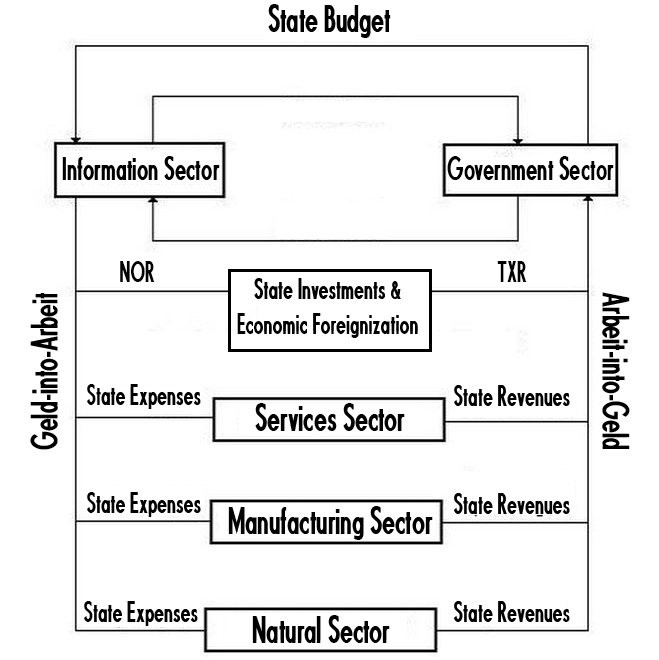
All VCS Economies under the Work-Standard is split into five “Economic Sectors” comprised of different “Industries” with various “Enterprises” and “Professions.” These five Economic Sectors are called the “Natural Sector,” the “Manufacturing Sector,” the “Services Sector,” “Information Sector” and “Administrative Sector.” All of the aforementioned Economic Organizations, the SAEs, SOEs, NSEs, POEs, and PDEs, can be found in each Economic Sector. As State Enterprises and Social Enterprises, they are denoted by their Social Rank, which is subject to change while competing within their respective Industries to create Arbeit and Geld in the VCS Economy’s “Tournament.” Instead of a Markets, the VCS Economy employs a Tournament to facilitate the transferring of Arbeit and Geld in return for goods and services between Enterprises and the Totality and State.
The Natural Sector refers to the cultivation and harvesting of both renewable and non-renewable natural resources and their subsequent refinement into raw materials, what the Work-Standard refers to as “Equipmentalities.” Agriculture, forestry, fishing, mining and so forth are all examples of economic activities within the Natural Sector.
The Manufacturing Sector acquires Equipmentalities from the Natural Sector and converts them into components, semi-finished products and finished goods. Construction, electronics, chemicals, engineering, glassmaking, fabrics, water purification and waste treatment are the dominion of the Manufacturing Sector.
Everything that is made by the Manufacturing Sector is transported, distributed, and sold by the Services Sector. The storage, maintenance and repair of finished goods can also be found here. Besides retail and hospitality, the Services Sector is also responsible for entertainment, gaming, finance, and various personal services such as barbershops and vehicle repair shops.
The Digital Economy, a concept introduced back Section One, is an Economic Sector called the Information Sector. All Digital Enterprises responsible for the facilitation, maintenance, and economic activities of the National Intranet, which houses the Digital Economy, can be found here. This includes the Digital Enterprises tasked with running and operating the digital infrastructure at the behest of the Council State.
The Administrative Sector pertains to the various economic activities where the creations of Arbeit and Geld are done by the Council State, Regional and Municipal governments. Mass transportation, healthcare, education and housing are the obvious examples, but they are not the only ones. The everyday functions of government bureaucracies contribute Arbeit and Geld. It is likewise true for “Military-Industrial Complex,” “State Media” publications, and civilian scientific research and development projects.
In all five Economic Sectors, the workforce is exerting “Life-Energy” to contribute Arbeit within a State of Total Mobilization. Life-Energy is defined by the Work-Standard as the naturally-occurring power that flows from every Self within their everyday economic and financial activities. By engaging in economic activities, everyone exerts Life-Energy to yield “Actual Arbeit,” which is then to be contributed to the “Life-Energy Reserve,” where the Central Bank converts it into “Actual Geld.” The precise amount of Life-Energy devoted to the creation of Arbeit across the various Economic Sector affects the Quality of Arbeit and in turn the Quality of Geld.
The Vocational Civil Service (VCS) Economy contains countless sources of Arbeit from every conceivable economic activity in the nation. Everyone who is employed in a Vocation in the VCS Economy, the Council State and all other institutions are capable of performing the process of turning Life-Energy into Arbeit. Through greater Economic Socialization (ES), the entire Professions and Enterprises are able to work together with other Professions and Enterprises in their Industry or with other Industries from different Economic Sectors to rack large returns of Arbeit. The large sums of Arbeit that have been created will yield an even larger sum of Geld.
The effects of Economic Socialization are considered as a common Force Multiplier (FM) that stems from the VCS Economy relying on Council Democracy rather than Parliamentary Democracy. Since everyone has both political and economic participation in the affairs of the State, Economic Socialization is capable of allowing various Professions to achieve achieving greater Work-Productivity (WP) whilst minimizing their overall Work-Intensity (WI) as the political process encourages the movement of information. The Council State can amplify the effects of allowing the flow of information to spread faster by means of three types of media that will be addressed in a later Entry: “State Media,” “Social Media,” and “Student Media.”
Categories: Compendium
 The Fourth Estate
Leave a comment