

How to Find Quality of Geld
Having discovered the Quality of Arbeit for a single Enterprise, we will now proceed with the conversion of Arbeit-into-Geld. To begin, we take the Quality of Arbeit and find the sum of its Economic Socialization (ES) value. Economic Socialization occurs whenever any economic activity results in the creation of Arbeit that enables at least one other economic activity. If we are focusing on a certain Profession or, in this case, a single Enterprise, we need to know how much Arbeit was created and how many Vocations or Professions were involved.
That Enterprise I introduced in the preceding Entry is not operating alone in the VCS Economy. Where does the Enterprise get its resources, tools, machinery, and other items? Who provides them with repair and maintenance services? Who transports their finished products from the storage are to a distributor? Who is the distributor and where are the products going to? Who buys the finished products and who needs them in order to render a service? Once we figure out how much Arbeit is also contributing to the production process and transactional sales of that Enterprise, we will eventually uncover how much that Arbeit is worth in Geld.
To find Quality of Geld, we now need to find the first half of the Solidarity Rate (SR1). The SR1 value is the quotient of the Scale and Duration of the production process. To find the Scale and Duration of the production process, we need to know how many finished products were created and how many transactional sales were conducted over the course of a given timeframe. In serious applications of the Work-Standard, an Economic Planner and their Accountants would assume that the Duration of Production is a given on any particular day. Unless the Council State happens to decide otherwise through legislation and enforced by the State Commissariats, there are forty hours within a single workweek.
Each day in the workweek consists of eight hours. Thus, the Duration of the production process should be eight (8) hours for a single day or forty (40) hours for a single week. The Economic Planner learns about the Scale of the production process from the Delegate or the Administrator. Depending on how the Enterprise is governed, the Economic Planner could get that information from the Delegate (if operating on Codetermination), from the Administrator (if operating on Joint-Ownership), or both (if operating on Workers’ Self-Management).
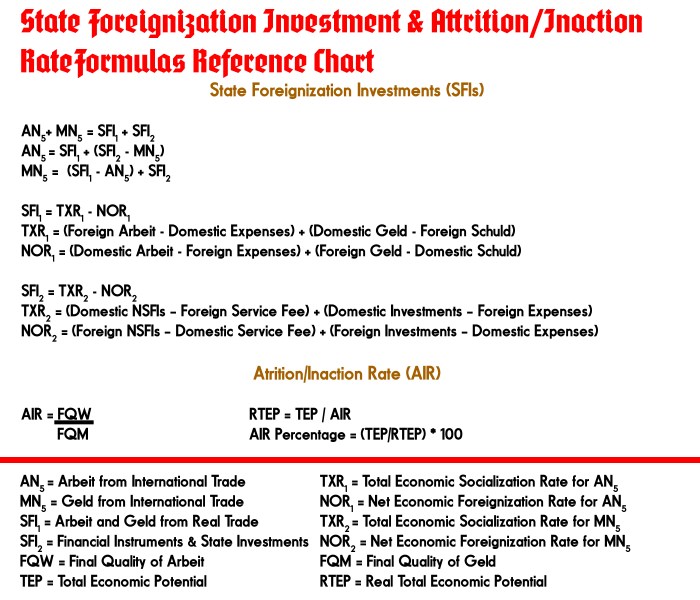
Whichever way the Economic Planner learned about the Scale of the production process, that variable will always be the number of produced, the number of services rendered, and the number of transactional sales conducted. Since we are only focusing on one Enterprise in the VCS Economy, its Quality of Geld can then be designated as the Final Quality of Geld (FQM). At this point, we should already have two separate values: one for the Final Quality of Arbeit (FQW), the other for the Final Quality of Geld (FQM). With those two values, we can finally use one of four methods to find the Attrition/Inaction Rate (AIR) for that Enterprise. This one involves taking the quotient of FQW and FQM to find AIR.

The pricing of goods and services are dependent on the Sustainability Factor, affecting whether the Quality of the production process can maintain the Frequency in which goods and services are being purchased within transactional sales. If the Frequency outpaces the Quality, the Price will rise because the production process is Unsustainable for everyone involved in its Domain. The reverse will occur if the Quality happens to surpass the Frequency.
State Foreignization Investments
Everything that I had just described up to this point was the Geld that got converted from the Arbeit associated with the production process and the transactional sales of an Enterprise. This is the procedure in which Arbeit is converted into Geld, thereby laying the foundations of the LER Account as the sum of Real Total Economic Potential (RTEP) and Real Total Financial Potential (RTFP), which requires finding the Total Economic Potential (TEP) and Total Financial Potential (TFP) respectively. That will be the topic of the next Entry.
But before we can find TEP and TFP values required to complete the LER Account, there is one final area that deserves mention in this Entry of the SMP Compendium. It should be recalled back in Section Six that the Socialist Nation is capable of generating Arbeit and Geld from International Trade, which the Council State is capable of encouraging under the terms of a Real Trade Agreement (RTA) with at least one other nation. All Arbeit and Geld gained from International Trade are identified as State Foreignization Investments (SFI1 and SFI2). The two variables denote the Arbeit and Geld that occur from exportation and those from importation.
- SFI1 is related to economic activities and factored as part of Final Quality of Arbeit (FQW).
- SFI2 is related to NSFIs and Foreign Investments under the Final Quality of Geld (FQM).
- Both variables involve finding the differences of their Total Economic Socialization Rates (TXRs) and corresponding Net Economic Foreignization Rates (NORs).
- Assuming we already know the values of FQW and FQM, we can now use two of the four methods to determine the Attrition Rate (AIR). These two methods are financial indicators that will allow us to determine the Attrition Rate across individual Professions, Enterprises, Industries, and Economic Sectors.
Categories: Compendium
 The Fourth Estate
Leave a comment