
It would be ignorant not to realize that Digital Arbeit, Digital Geld, Military Arbeit and Military Geld, NSFIs and Work-Tenures represent the supplementary contributions to the Life-Energy Reserve by the Totality and the Council State. The National Intranet, as part of the VCS Economy’s Information Sector and under the oversight of the Ministry of Science and Technology, and the Reciprocal-Reserve Banking System are just as capable of creating national wealth. The same assertion can also be extended to the Military-Industrial Complex.
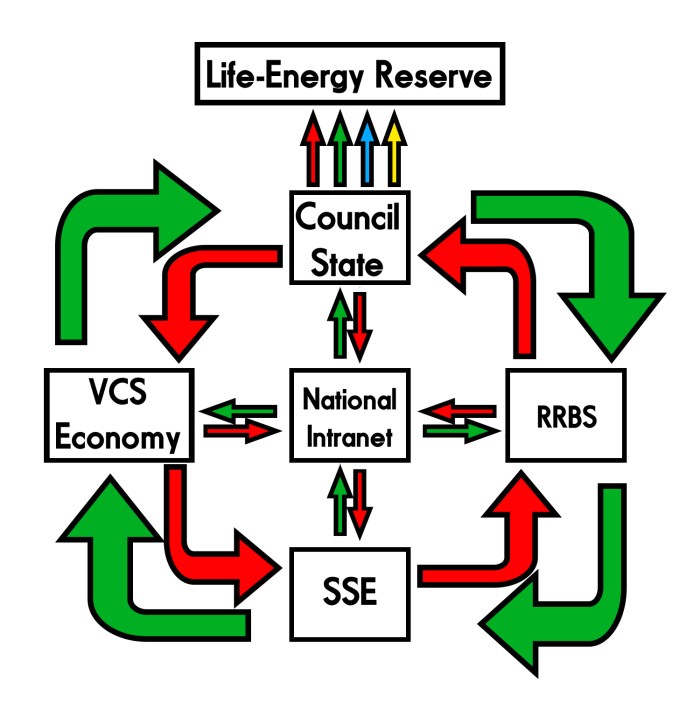
On the National Intranet, the LERE (Life-Energization Reciprocal Electrification) Process has Digital Arbeit and Digital Geld originating from all economic and financial activities on the National Intranet of the Socialist Nation, its access to the International Internet and a National Intranet of another Socialist nation with its Currency pegged to the Work-Standard. With the VCS Economy and the SSE relying on their own Tournaments, it becomes inevitable to envisage a third Tournament that exists in the Digital Economy and acts as the intermediate between those two Tournaments. The National Intranet’s Tournament is only made possible because of the LERE Process and the Social Forums that preside over the Digital Economies.
Preliminary Precautions

To begin, it is important to understand that all Digital Enterprises are capable of contributing Actual Arbeit and Actual Geld as well as Digital Arbeit and Digital Geld. The Actual Arbeit and Actual Geld comes from the construction, operation and maintenance of the digital infrastructure behind the National Intranet. Those contributions are always accounted for in the Information Sector of the VCS Economy. The Digital Arbeit and Digital Geld, meanwhile, comes from allowing the Totality to create digital goods and render digital services on the National Intranet through the Tournament. The latter is always affected by the LERE Process.
A good example is the concept of eCommerce. There is Digital Arbeit and Digital Geld from the production of digital goods and the rendering of digital services. As for the Actual Arbeit and Actual Geld, somebody else was responsible for operating and maintaining the storehouses where the finished products are stored. Somebody else was also responsible for transporting, distributing, and delivering an ordered product to the customer. Their contributions have to be accounted for with the rest of the VCS Economy.
When Economic Planners and Accountants of Digital Enterprises determine their contributions of Digital Arbeit and Digital Geld, they do so separately from the contributions of Actual Arbeit and Actual Geld. After obtaining the Quality of Arbeit and Quality of Geld for the Digital Enterprises, they proceeded to determine the TEP and TFP values, followed by the RTEP and RTFP values with the Attrition/Inaction Rate. Only after they have found the RTEP and RTFP values will the Economic Planners and Accountants start finding the Quality of Digital Arbeit (EDW) and the Quality of Digital Geld (EDM). The EDW is added toward the RTEP value and the EDM value is added toward the RTFP value.
How to Find Qualities of Digital Arbeit and Digital Geld
The Economic Planner and their Accountants begin by multiplying Work-Productivity (WP) and Force Multipliers (FMs), subtracting it from Work-Intensity (WI), and then multiplying it again by the number of machines per Profession. The same operation would be repeated for the Vocations in charge of the machinery. The sum of the Arbeit done by the Vocations and those done by the machines were multiplied by the Mechanization Rate (MR). All Expenditures were then deducted to yield Quality of Digital Arbeit (EDW).
For Digital Geld, the value of the Arbeit done by both the Vocations and the machinery were added toward the sum of Economic Socialization (ES) and the first half of the Solidarity Rate (SR1). Most Digital Enterprises are guaranteed to allow other Enterprises to conduct themselves on the National Intranet in one form or another. A single Digital Enterprise eCommerce website for instance could allow hundreds of small Social Enterprises, like Cooperatives, Small Businesses and Workshops, to contribute additional sources of Actual Arbeit. This is referred to in the LERE Process as “Arbeit begetting Arbeit,” its implications to be explored in another Treatise.
Unlike the ES value, SR1 as the quotient of Scale and Duration of the production process remains the same, as is the other half of the Solidarity Rate (SR2), the Scope and Density of the production process. When both halves of the Solidarity Rate have been accounted for, the final step is to add all Revenues that the Digital Enterprise had gained from its transactional sales. The Quality of Digital Geld has been uncovered.
One will notice that not once was the Attrition/Inaction Rate. Instead, the Quality of Digital Arbeit was included with the sum of RTEP and the Quality of Digital Geld with the sum of RTFP. The Implicit Intent has to do with the fact that the Vocations involved are relying on the machinery to performance their economic activities. The Actual Arbeit and Actual Geld to be gained from Professions like computer software programming is more indirect and less direct than the Profession that was responsible for manufacturing the computer hardware. More importantly, Digital Enterprises and their related Professions are the ones that the Central Bank calls upon to implement the automated technologies of the Mechanization Rate.
Contributions from the Military-Industrial Complex
Besides Digital Arbeit and Digital Geld, Economic Planners and Accountants in the Military-Industrial Complex are responsible for overseeing the contributions of Military Arbeit and Military Geld. In the Council State, the Armed Forces contribute Military Arbeit and Military Geld by defending the Socialist Nation. In the VCS Economy’s Administrative Sector, the Armaments Industry contributes Military Arbeit and Military Geld through the manufacturing, transportation and distribution of everything that Armed Forces will need. While the Armed Forces have their own dedicated Economic Planners and Accountants in the Ministry of War, civilian Economic Planners and Accountants are assigned to State Enterprises in the Armaments Industry.
Military Arbeit and Military Geld, unlike Digital Arbeit and Digital Geld, can be easily converted into Actual Arbeit and Actual Geld. Military Arbeit and Military Geld become Actual Arbeit and Actual Geld whenever the Central Bank is capable of gaining access to financial information on the Military-Industrial Complex from the Council State. Any military actions that the Council State feels safe to disclose to disclose to the Central Bank will immediately have the Military Arbeit and Military Geld turned into Actual Arbeit and Actual Geld. In the Final TTP Value, they can be found under the Council State’s contributions to the Life-Energy Reserve.
Compared to the Armed Forces, the Economic Planners and the Accountants in the Armaments Industry will have an easier time figuring out the Quality of Arbeit and Quality of Geld for their Enterprise. This is because the Military Arbeit and Military Geld from the Armaments Industry is automatically converted into Actual Arbeit and Actual Geld. The VCS Economy’s Administrative Sector is supposed to be more transparent about what it is doing and the Armaments Industry should be no exception.
Contributions from Financial Investments
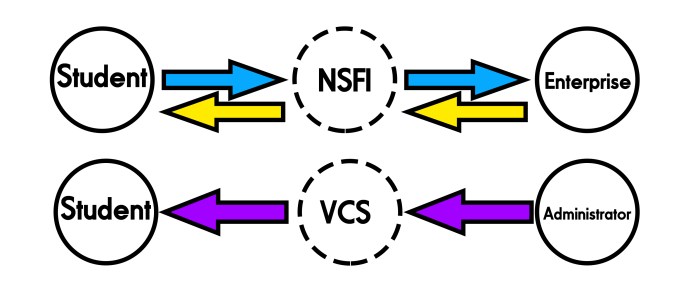
All NSFIs issued by the Kontore are only designed to ensure contributions of Actual Arbeit and Actual Geld to the Life-Energy Reserve. An Investor purchases an NSFI from the Kontor, pays its Service Fee, and proceeds to devote their Life-Energy to the production process of the Enterprise affected by the NSFI. Most NSFIs are designed to enable the Investor to receive Actual Geld in addition to the Paygrade that the Council State wires to their personal bank account at the end of each workweek.
The Work-Tenures issued by National-Socialized Banks (NSBs) are Interest-free loans that involve contributions of Actual Arbeit and Actual Geld. For every Work-Tenure that an NSB lends, both the lender and the borrower contribute Actual Arbeit and Actual Geld to the Life-Energy Reserve. The arrangement is very similar to that of a Real Trade Agreement (RTA), except the borrower and lender each contribute half of their Arbeit and half of their Geld to the Work-Tenure. Both the lender and the borrower are expected to pay the Work-Tenure through their own contributions of Arbeit and Geld. To break even or to generate additional Arbeit and Geld for the Life-Energy Reserve, the lender and the borrower will need to contribute more Arbeit and Geld than whatever amount of Actual Geld that they had agreed to under the terms of their Work-Tenure. Failure to do so will result in them accumulating Schuld.
Where simply allocating more Actual Geld from the State Budget would not suffice, the Council State is capable of employing taxation and investment policies. The Council State could impose Sonderabgaben (Special Charges) on the economic activities of State and Social Enterprises, the Revenues of which go directly to the affected Enterprises. People’s Surcharges may be implemented on Specialty Shops and Foreign Enterprises to reduce the amount of Actual Geld that leaves the Socialist Nation. The latter becomes relevant when the Totality trades their Sociable Currencies for foreign currencies.
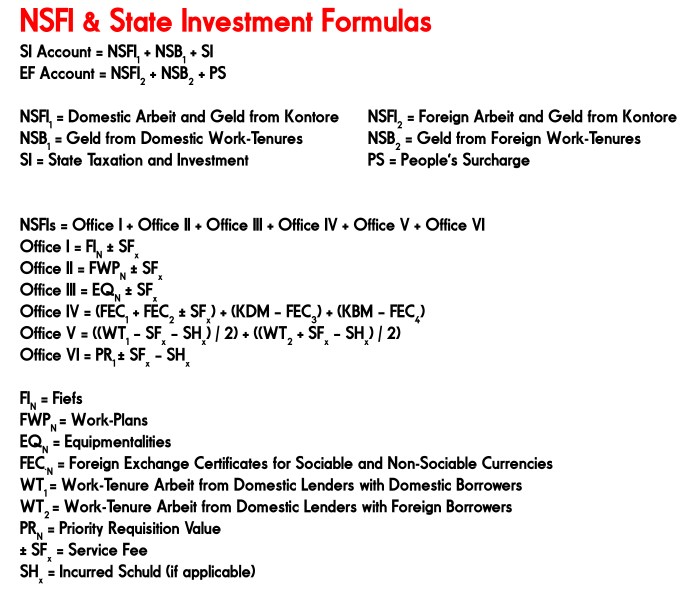
For the Economic Planners and Accountants filling out the WSAs with the Reciprocal-Reserve Banking System, the SI-EF Account of their Enterprise becomes relevant. Since their Enterprise is basically allowing Investors to contribute Arbeit and Geld to the Life-Energy, the contributions of the Investors will count as a source of Economic Socialization and as a Force Multiplier. Remember, one of the Force Multipliers of the LER Process is the ability of an Enterprise to encourage Economic Socialization through its own economic activities. Here, we must immediately recall the operational procedures of finding the Quality of Geld. After finding the Enterprise’s Quality of Arbeit, we then needed to figure out whether the Enterprise was also allowing other sources of Arbeit through Economic Socialization and how many other Vocations are involved, and then multiply the first half of the Solidarity Rate.
If there are other Vocations affecting an Enterprise’s ES value, such as the Investors of an NSFI related to that Enterprise, their Quality of Arbeit and the number of their Vocations will need to be accounted for. Only when all sources of Arbeit are accounted for should the Economic Planners and Accountants be determining their Enterprise’s Expenditures and Revenues. The Investors, because of their involvements in the production process and transactional sales, will be affecting the Enterprise’s Expenditures and Revenues. That too needs to be accounted for.
Categories: Compendium
 The Fourth Estate
Leave a comment