
The National-Socialized Financial Instruments (NSFIs) of the Kontore function differently from the Liberal Capitalist Financial Instruments (LCFIs) that are found at the Financial Markets. They operate according to the interplay between Arbeit and Geld and the Intents of Command and Obedience. Certain NSFIs are designed to act as reserves of Arbeit and Geld that can be mobilized by the Council State and the Totality, allowing for a massive injection of Arbeit and Geld into the VCS Economy, the SSE or the National Intranet as needed. Kontore are also authorized to sell the raw materials harvested from natural resources as the Equipmentalities with specific Reference and Relevance in mind. They can facilitate transactions pertaining to the conversion of the nation’s Currency into that of another Currency.
The largest NSEs at the Kontore are going to be NSBs (National-Socialized Banks) issuing larger Work-Tenures to cover the creation of new Vocations among enterprises. They can also facilitate the entry of foreign enterprises from nation-states also operating under the Work-Standard. Any foreign enterprise that wishes to establish branches in the Socialist Nation will be dealing with the economic planners assigned to the Kontor of a major city or metropolitan area.
Just as how the State Commissariats prohibit “labor strikes” and “lockouts” within the workspace and any one-sided negotiations for higher wages, the Kontore also prohibit “asset speculation.” Speculation is a commercial device hostile to the interests of the Council State and definitely harmful to the Totality’s livelihood. Anyone who feels a genuine need to seek a Transvaluation of all Arbeit, including the Prices of certain goods and services, will be asked to report to their local state commissars at the State Commissariat of a major city in their area.
Each Kontor is comprised of eight Offices, six of which are dedicated to the issuance of specific types of NSFIs. Its jurisdiction encompasses that of a Regional Government, with local branches serving the Municipal Governments. One Office is tasked with fostering the encouragement of foreign investment by Foreign Enterprises, selling Domestic NSFIs to Foreigners and Foreign NSFIs to the Totality. The last Office is primarily administrative, consisting of detachments of Central Planners and Superintendents in charge of subordinate Economic Planners and Accountants as well as State Commissars and Inspectors. The role of that last Office is to conduct the everyday operations of a Kontor and its various local branches.
‘Office I’ deals with “Fiefs,” the investments of Life-Energy into the Arbeit of an enterprise by vocational civil servants. Someone’s involvement here has the potential convince the State Council that this person and everyone else deserves a larger Paygrade next week. They replace the need for stock markets and labor markets, low-paying temporary work and independent contracting of the gig-economy and deliver some much-needed respect to those doing menial tasks. These include and are never limited to delivering everyday mail and goods ordered from eCommerce websites, flipping burgers behind the grill, taking orders at a restaurant waiter, hospitality and catering, manning the receptionist desk at office buildings and those other ‘boring’ assignments that most people tend to look down on under Liberal Capitalism.
By purchasing Fiefs and paying all Service Fees, Investors invest in an Enterprise by directly engaging in its production process and transactional sales, essentially establishing a temporary Vocation that can become permanent with the approval of the Enterprise’s Administrator. The Council State will ensure that the Investors’ room and board is paid for at the behest of the Kontore. But there is another variation of the Fief that is worthy of mention. In addition to the ability for Enterprises to receive additional sources of Arbeit from Investors, the personnel will also be able to gain shares in the State Funds of certain Social Enterprises such as Cooperatives and Small Businesses through Fiefs.
The practice of gaining a share of a Social Enterprise by a Civil Servant with a Vocation in that Social Enterprise is called “Life-Energy Charging (LEC).” Social Enterprises like Cooperatives, Small Businesses or Workshop form the foundational bedrock of the economic activities in the VCS Economy and the SSE. Where State Enterprises provide goods and services geared toward mass production processes, Social Enterprise are more likely to specialize in niche mass customization processes. This in turn gives Social Enterprise additional Intents to achieve Economic Socialization with Fiefs and enhance their overall Solidarity Rate by diversifying their economic activities beyond their primary production process.
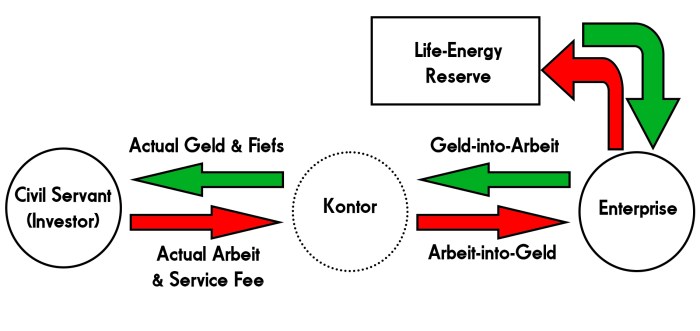
‘Office II’, the other important segment of the Kontor, provide “Work-Plans” issued by the Council State, the State Enterprises, and Social Enterprises of the VCS Economy, the Student Enterprises of the SSE, and the Digital Enterprises of the National Intranet. In a functioning Council Democracy, the Delegates of each Enterprise convene regular meetings with the Administrator and the Economic Planner on the current state of affairs. The Delegate may propose the issuance of Work-Plans with the approvals of the Economic Planner and the Administrator. The Council State, meanwhile, is guaranteed to issue Work-Plans regardless of whether the Enterprises are issuing them.
Work-Plans are assignments related to one’s Vocation as part of climbing the Social Ranks and for those willing to demonstrate industriousness and ambitiousness within challenging tasks. A Work-Plan may be designed to be either long-term participation to the production processes and transactional sales of an Enterprise or involve carrying organizational projects, programs and initiatives that an Enterprise needs additional manpower. Most Work-Plans last four or five years, but arrangements can be made with a Kontor to issue special Work-Plans applicable to twelve-month or ten-year timeframe. Each Work-Plan is administrated by an Economic Planner, usually the one assigned to the affected Enterprise. For Work-Plans issued by the Council State, the Economic Planner may sometimes be the one that issues the Work-Plan to the Investor back at Office II. In any case, the Economic Planner and Investors are responsible for the completion of the Work-Plan prior to its Maturity Date.
All Work-Plans have a Maturity Date. If an Investor succeeds in completing the goals outlined in the Work-Plan two or more years before the Maturity Date, they are entitled to receive an additional Stipend from the Council State in recognition of their achievements. If the Investor turns in the Work-Plan within two years before the Maturity Date, they will only receive the Actual Geld at face value. But should the Investor decide to turn in the Work-Plan less than three months after the Maturity Date, they will receive half of the Actual Geld. However, if more than three months have passed and the Investor turns in the Work-Plan, they will also receive a fixed sum of Schuld from the Kontor for failing to take the initiative of turning in the Work-Plan on schedule.
‘Office III’ is involved in transactional sales of Equipmentalities and is split into suboffices. “Group A” provides Enterprises and Industries in the Natural Sector of the VCS Economy with ample amounts of Actual Geld from the Council State and Investors. State Investments from the former are spent on the harvesting of natural resources and their subsequent conversion into Equipmentalities. Group A can also issue Equipmentality NSFIs to potential Investors interested in participating in the production processes of those same Enterprises and Industries or the transactional sales of the Equipmentalities at the Tournament. Investors engaged in the former may be allowed to convert their investments into new Vocations; those who assisted in the Transactional Sales are entitled to receiving a Stipend from the Council State.
“Group B,” on the other hand, is tasked with the transportation, distribution and delivery of the Equipmentalities procured by Group A. The same Equipmentality NSFI rules associated with Group A are also applicable to Group B. Investors who are engaged in the affected production processes may be rewarded with their own Vocations. Those who assisted the transactional sales will instead receive a Stipend. Either way, the State Commissariats reserve the final authority on how much Investors would receive in Stipends, assuming the Investors had decided to participate in the production processes and refused to convert the Equipmentality NSFIs into Vocations.
The official designation of ‘Office IV’ is “Currency Conversion.” It oversees the exchanges of the Socialist Nation’s Sociable Currency into other currencies, including those from any countries that are also pegged to the Work-Standard. The Central Bank is responsible for setting the official Exchange Rates between the Sociable Currency and all other currencies. Depending on whether the World State Organization (WSO) exists, Office IV may issue FECs (Foreign Exchange Certificates) to any Foreigners who happen to be Investors. FECs are designed to limit the amount of Foreign Geld that Foreigners are allowed to obtain from the Socialist Nation outside of contributing their Arbeit to the Life-Energy Reserve.
Alternatively, Office IV could allow the Totality to exchange their Sociable Currency into the official World Reserve Currency of the World State Organization. Those concerned about the influence of Cryptocurrencies in the National Intranet will be reassured that this is also the same place for matters related to the Work-Standard within the Digital Realm. This includes the automated processing of transactions into different currencies and the tracking of their movements across international borders.
The Earmarked Requisitions of State Banks and National-Socialized Banks in the Reciprocal-Reserve Banking System is handled by ‘Office V’. This particular segment of the Kontor is involved in the allocations of Actual Geld intended for the lending of Work-Tenures by the NSBs. How much Geld that Office V can provide to all NSBs in the Socialist Nation is determined by the Central Bank at the behest of the Head of State and the State Council. With regard to the State Banks, Office V assists them in overseeing the distribution of Paygrades. Should any State Banks or NSBs find themselves in need of additional Actual Geld, Office V will be the one to provide additional Actual Geld as well as Schuld for failing to avoid any deficits.
‘Office VI’ plays an important role in the Reciprocal-Reserve Banking System as far as the VCS Economy, SSE, National Intranet and the Council State are concerned. Its official designation is known as “Priority Requisition (PR).” Exactly what PR pertains to can be discerned from the designations of the four Groups that comprise Office VI. Those four Groups are known as “Non-State Research and Development,” “Technical Patents and Field Prototype Evaluations,” “Intellectual Property and Mass Communications,” and “Non-State Acquisitions and Strategic Investments.”
“Group A” handles the allocations of State Funds toward research and development projects as well as the deployments of any new technologies, including those related to the Central Bank’s Mechanization Rate. “Group B” provides Technical Patents and Production Licenses as well as oversee the prototype demonstrations of technologies developed by State Enterprises and Social Enterprises. “Group C” oversees all of the Arbeit-into-Geld conversions from economic activities related to Social Media and Student Media, especially those related to Digital Enterprises. But neither of those Groups hold a candle to the endeavors of “Group D.”
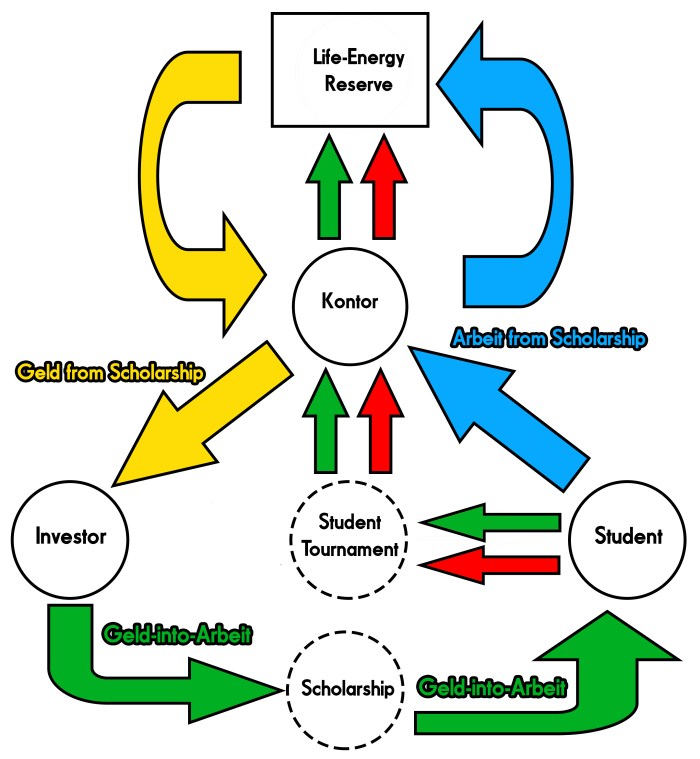
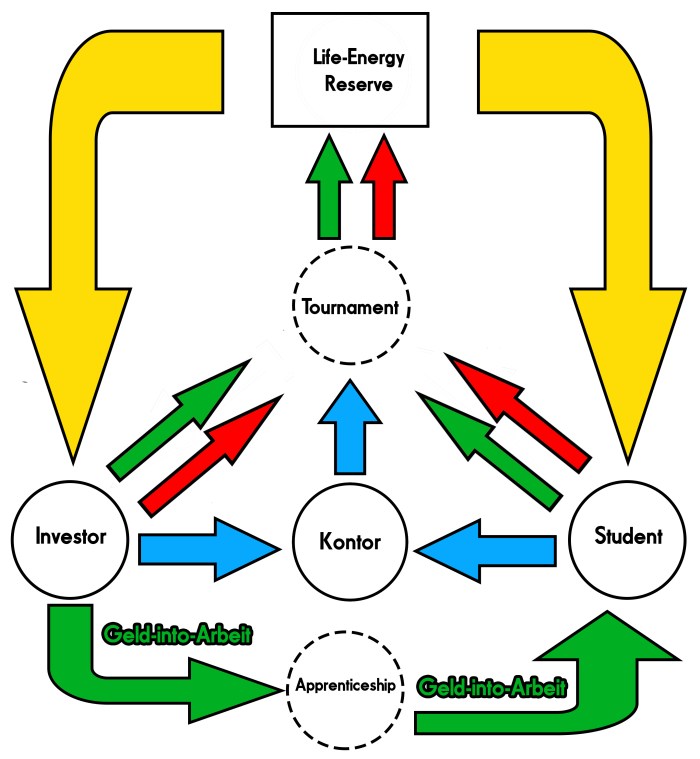
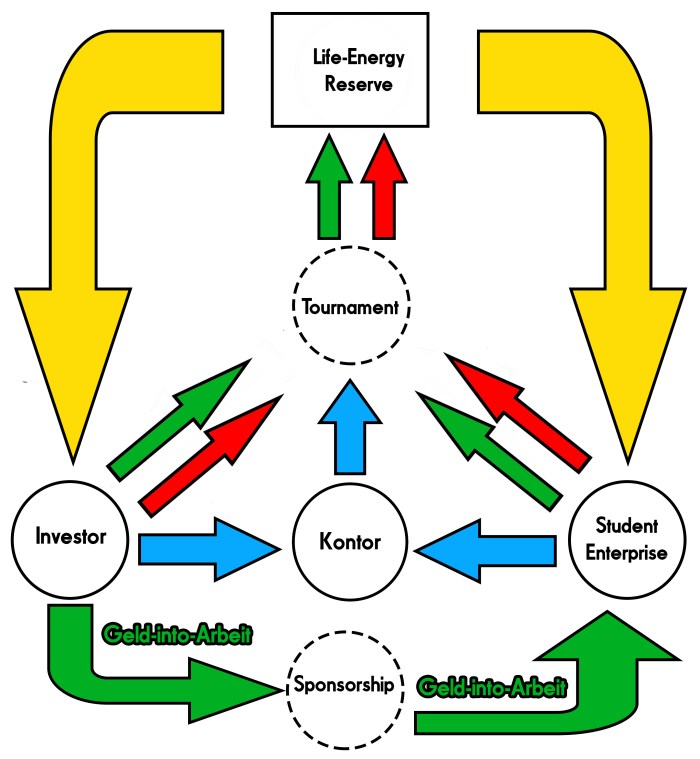
The Economic Planners and Inspectors of Group D offer NSFIs that facilitate secondary allocations of Arbeit, Geld, and Equipmentalities to the SSE, VCS Economy, Reciprocal-Reserve Banking System, Council State or National Intranet. They provide the means by which the wealthiest among the Totality invest much of their wealth back into the Socialist Nation. Donations and fundraising are overseen by Group D. Group D is also tasked with the issuance of three special NSFIs exclusive to the SSE and supported by the wealthiest among the Totality. These three special NSFIs are called “Scholarships,” “Apprenticeships,” and “Sponsorships.”
Scholarships function as the NSFI for Students who need Arbeit, Geld and Equipmentalities for their official ventures as part of the SSE. An Apprenticeship functions in a similar manner except it applies to their Vocation as part of a Profession in an Enterprise in the SSE or the VCS Economy. The same can be said for the Sponsorship being the equivalent for establishing new Enterprises for either the SSE or the VCS Economy. Eligibility for all three depends on the Social Rank of the recipient. The Service Fee will be charged to the recipient instead of the wealthy. Moreover, the Council State may confer Scholarships, Apprenticeships, or Sponsorships to Students as Prizes.
The last two Offices are concerned with the Economic Foreignization and the Economic Governance of the Kontor. The affairs of Foreign Enterprises and the activities of State, Foreign, Student and Digital Enterprises outside the Socialist Nation fall under the purview of ‘Office VII’. Investors must be bilingual, be familiar with other cultures and demonstrate a willingness to work alongside Foreigners within the Office’s two Groups. “Group A” coordinates Enterprises operating outside the Socialist Nation, whereas the oversight of Foreign Enterprise pertains to “Group B.” The size and composition of Office VII is affected by the Council State’s Real Trade Agreements (RTAs) with other nations. In command of all seven Offices is ‘Office VIII’, designated “Administrative Faculty.” There are separate detachments of Central Planners and Superintendents that participate in these Kontore, both of whom have their own subordinates embedded in each of the other seven Offices and their corresponding Groups.
Categories: Compendium
 The Fourth Estate
Leave a comment