
National-Socialized Financial Instruments (NSFIs) are designed to not only allow the Kontore to become proper alternatives to Financial Markets, they also overcome the well-known shortcomings of most conventional types of economic planning. Their goal is to realize the conceptualization of an entirely different type of economic planning unlike STEP (Soviet-Type Economic Planning) and PTEP (Prussian-Type Economic Planning). This “Mission-Type Economic Planning” (MTEP) takes its inspiration from the Prussian “Auftragstaktik” (Mission-Type Tactics) by reapplying it to economic and financial contexts. Understanding the secrets behind MTEP and its relationship with NSFIs requires a careful definition of Auftragstaktik in its original Prussian conception.
Auftragstaktik was developed by the Prussian armed forces as a consequence of military defeats during the Napoleonic Wars, particularly in the wake of the Battle of Jena in 1806. The use of “Befehlstaktik” (Order-Type Tactics) during the Napoleonic Wars proved disastrous in maintaining cohesion and minimizing misunderstandings between the commander’s Intent and the actions of their subordinates. Unlike Auftragstaktik, Befehlstaktik paid greater attention to the means by which subordinates carried out their orders, with the superiors focusing less on the outcome of those orders. This discouraged initiative from the subordinates and overburdened the superiors with a deluge of conflicting orders and responses as well as struggling to maintain cohesion in the heat of battle.
By reforming their armed forces after the Napoleonic Wars, the Prussians introduced Auftragstaktik as a cultural philosophy, rather than an actual military tactic per se. They wanted to reduce over-centralization within their general staff and the over-dependency of field officers and subordinates to expect orders from superiors. The best way to define the core fundamentals of Auftragstaktik can be described by the following paragraphs.
Great emphasis is placed on the outcomes of the commands given from superiors to their subordinates, giving them both the means to carry them out and an allotted timeframe by which to do so. A strong bond of mutual trust and camaraderie among the ranks is allowed to develop as the subordinates strive toward leadership and professionalism by an educational system that inculcates that command culture and the Socialization that is more commonly associated with the Solidarity of Socialism. Enabling the Socialization and the inner-feeling of Solidarity between the superiors and the subordinates is the Intents of Command and Obedience. Yes, the same Intents of Command and Obedience that is antithetical to the Incentives of Supply and Demand.
Latent character traits among individuals demonstrating a joy and love of taking on the higher responsibilities of service within one’s Vocation in Life, knowledgeable expertise, independence, self-reliance and self-organization are demonstrative of excellent leadership. Those traits should be refined further at educational institutions in order to realize their fullest potential. Such Individuation will prove necessary in order to emphasize initiative and swift action without having to wait for superiors to receive access to perfect information in conditions where communications tend to become muddled and reliable information is scarce.
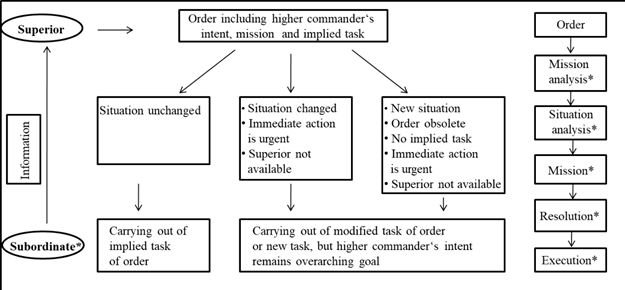
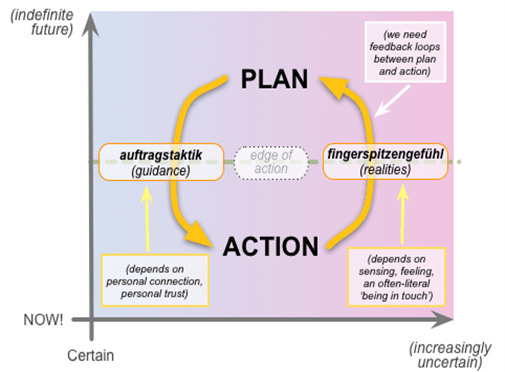
One cannot always expect to be given orders all the time and expect the superiors to tell the subordinates what has to be done. It becomes necessary for the subordinates to eventually demonstrate leadership and take the initiative on their own until a new set of orders arrive from their superiors. Awareness of the “Selbständichkeit” (change of orders) is crucial in knowing when to disregard one’s orders. This is because Auftragstaktik is not an excuse to do as one pleases or commit actions that could violate their orders without understanding the Intent behind why those orders were originally issued. As long as the Intents of Command and Obedience are maintained, any old orders can be safely disregarded by newer ones as conditions change. The following diagrams demonstrate the thought processes behind Auftragstaktik:

Like the Central Planners and the Superintendents, all Economic Planners, Accountants, Inspectors, and State Commissars are expected to be educated at special higher institutions intended to foster any latent talents of administration, monetary and fiscal policies, macroeconomics and national finance. The curriculum is designed to be as rigorous as the one for the general staff of an armed forces. A part of their schooling, they will have them be properly acquainted with hands-on training and experience in the Vocational Civil Service (VCS) Planned/Command Economy through the SSE and its Student Tournament. They will tour the various workspaces among the Student Enterprises, acquainting themselves with the various Professions and Vocations that they will be assigned to upon graduation.
Furthermore, it is due to Auftragstaktik being capable of reapplication within economic and financial contexts that the concept of Mission-Type Economic Planning (MTEP) becomes feasible. Auftragstaktik does require some level of organized centralization, which in turn necessitates the need for a special educational curriculum for those intimately involved in the LER Process. The Intents of Command and Obedience are essentially what separates MTEP from the more ‘decentralized’ and ‘indicative’ types of economic planning employed in certain Western countries like France or Japan. And it also those same Intents that has made the conceptualization of the NSFIs so promising for the Work-Standard.
An NSFI is best understood as embodying characteristics of a financial instrument and an economic plan. The simplest and most fundamental variants are the Four-Year and Five-Year Work-Plans, which are issued by the State at the Kontore. A Work-Plan may be purchased by an individual Self, the members of a local Guild or an Enterprise. The execution of a Work-Plan will affect the economic activities of State Enterprises, Social Enterprises, Student Enterprises, Digital Enterprises and Foreign Enterprises.
The secret of the Work-Plan is the convertibility between the amount of Arbeit contributed from the recipient to the State. Each Work-Plan will provide the Investor with the necessary education and means to execute it. And on a specified “Maturity Date,” preferably within the given timeframe, the State will pay the recipient the amount listed on the Work-Plan itself. This in turn overcomes the need to maintain Kapital to facilitate the borrowing and lending of Liberal Capitalist Financial Instruments (LCFIs) for Schuld (Debt/Guilt) with or without Interest. Instead of the LCFIs’ dialectics of Kapital and Schuld, all NSFIs rely on Arbeit and Geld.
Issuance of Work-Plans at the Kontore has an Economic Planner, usually the one assigned to the Enterprise that the Work-Plan affects, working alongside the Investor in carrying out the terms of the Work-Plan. The Economic Planner serves as the intermediate between the Central Planners and the recipients of the Work-Plan, their Accountants acting as their assistants. Once the Maturity Date has passed, the Economic Planner becomes no longer responsible for overseeing the economic activities of the Investor.
Should there be an inexplicable event that prevents the recipient of an NSFI from contributing Arbeit, anything from accidental injury or death to a declaration of war or political turmoil, a premature cancellation the NSFI is likely. If that happens, Kontore will have ample reserves of Geld available as Earmarked Requisition from the Council State to immediately pay compensation for the sudden end of any and all NSFIs.
Granted, it is possible that the Work-Plans may not be the only kind of NSFIs available. It may become feasible to envisage other NSFIs intended to replace the need for any and all LCFIs at the Kontore. Whether they will be elaborated upon in sufficient detail is the topic of a future entry to the Compendium.
Categories: Compendium
 The Fourth Estate
Leave a comment