
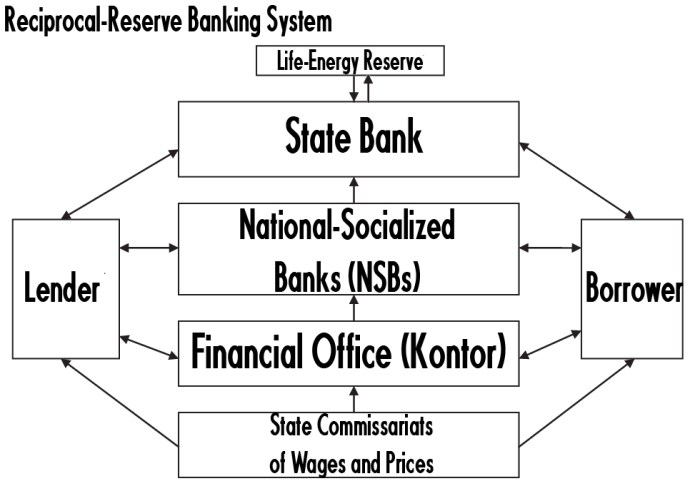
Conventional banking practices will be revolutionized by the Reciprocal-Reserve Banking System. Its methodology differs from those found in Liberal Capitalism and most historical and existing Socialisms. No other Socialism has been able to realize this for reasons that pertain to the very concept of Sociable Currency being pegged to Arbeit. All National-Socialized Banks and State Banks will operate as the subordinates of the Central Bank, the Central Bank subordinate to the State Council and Heads of State and Government in the Socialist Nation. The State wields the Intents of Command and Obedience.
The State Banks are State-Administrated Enterprises (SAEs) in terms of political-economic governance. That means following the Direct Orders of the Council State itself, which involves assisting in the LER Process and in the distribution of Paygrades to the Totality. National-Socialized Banks (NSBs), on the other hand, are National-Socialized Enterprises, which means that they are somewhere between State Enterprise and Social Enterprise. Unlike the Fractional-Reserve Banking System, where it was the privatized commercial banks that helped the Central Bank decide how many units of currency could be put into circulation, it is the Totality that is helping the Central Bank decide under the Reciprocal-Reserve Banking System.
The parameters established in preceding Entries with regard to Work-Tenures deserve to be restated here. Work-Tenures are made possible because of the Reciprocal-Reserve Banking System creating a precedent in which the National-Socialized Bank offers an Interest-free loan that has be paid off through contributions of Arbeit and Geld. The lender contributes 50% of their Arbeit to the loan the borrower contributes 50% of their Arbeit to the loan, allowing the borrower to break even or to contribute more Arbeit and Geld to the Life-Energy Reserve. To obtain a Work-Tenure, the borrower must be of a certain Social Rank and be willing to pay a “Service Fee” to the National-Socialized Bank for consulting its services.
When the borrower visits an NSB, the NSB may be expecting them to borrow a loan. The borrower is doing it on their own volition because they are convinced something needs to be done but they lack the Geld needed to make it happen. The borrower may have a payment card and they need the bank to put Geld into it to pay for something sooner rather than later. The borrower could be an artist looking to commission a new work of art that is beyond what the Council State normally allocates to them in Stipends. They might be starting their own Social Enterprise or they could be looking for potential financiers besides the Council State and Kontore.
Always remember the amount of Work-Tenures each NSB is capable of lending to potential borrowers is dependent on the Earmarked Requisitions determined by the Central Bank. The Geld that goes into each Work-Tenure has to come from somewhere. Since the State Bank are responsible for the LER Process, the Paygrades and personal savings accounts, this leaves the NSBs as the ones tasked with the issuances of Work-Tenures. Anyone who fails to pay what they owe to the NSBs will begin to accumulate Schuld as a consequence.
Furthermore, how would the Reciprocal-Reserve Banking System revolutionize the role of borrowing loans for making large-scale purchases like homes, automobiles, and higher education? What is the relationship, if any, that Schuld has with payment cards, seeing how “credit cards” as they are commonly understood do not exist under the Reciprocal-Reserve Banking System?
Under the Work-Standard, there are now additional opportunities for someone to acquire the Actual Geld in the Reciprocal-Reserve Banking System. University students pay for their education by participating in the affairs of the SSE. Paygrades, Stipends, and NSFIs are the three most common means of obtaining the Geld to buy land, buildings, cars, boats, and planes. If one’s Vocation happens to be in Social Enterprises like Cooperatives or Small Businesses, the Geld made from transactional sales can be distributed among its Civil Servants. It should also be remembered that Paygrades are adjusted according to years of service and number of dependents. The longer somebody is devoted to their Vocation, the more Geld they are likely to receive.
Young people under the Work-Standard do not have to spend a third of their adult years depending on their parents as is the case under Liberal Capitalism. In the Socialist Nation, they are entitled to receive their very own Paygrade by deciding to pursue a Vocation early on in their secondary school years. Those who do not are allowed to continue their education at the tertiary educational level or be allowed to volunteer to join the Armed Forces. For those who have not yet decided on what they want to do with their lives, they get to receive a draft card in the mail upon turning the age of eighteen.
The draft card does not necessarily have to be a three-year conscription into the Armed Forces; it can just as easily be a three-year conscription into any Enterprise that needs help from the youth. In return for committing their Life-Energy to the Vocation that they had been conscripted to serve under, the conscript will be entitled to receive a Paygrade at the same rates as a volunteer. This is their chance to save Geld for the future because the longer somebody is involved in a particular Vocation that they are called to pursue, the more Geld they will be receiving from the Council State. The Arbeit to be contributed from either decision is worth it over the long run in terms of more Geld received on a weekly basis.
Remember that a university education is going to become cheaper under the Work-Standard, especially since the Professions related to the national educational system contribute far more Arbeit and thus more Geld for the Totality. A similar occurrence will also be discerned on the assembly lines of manufactured automobiles, affected by their overall Work-Intensity (WI) in the production process and the Mechanization Rate set by the Central Bank. Housing will also become cheaper under the Work-Standard because land and buildings are not commodities in themselves; they belong to the Totality on the grounds of National Sovereignty.
In a functioning Council Democracy, the Totality governs the Council State and they own their nation and its soil, entrusting the Council State to care for the land and the buildings. The moment any citizen decides to purchase a plot of land or a building is when it finally belongs to them alone. When they sell that same plot of land or building, it is temporarily under the State’s control until somebody else decides to buy it. And the people who are going to take care of that land and building until that next purchase will be the youths themselves as one of the ways they will be earning a decent Paygrade from the State.
Categories: Compendium
 The Fourth Estate
Leave a comment