
The 20th century witnessed revolutionary changes in every facet of life for all nations. Its influences still persist in the 21st century. The most important development has been the recent emergence of the “State of Total Mobilization,” a metaphysical concept derived from the thesis of Ernst Jünger’s 1930 essay “Total Mobilization” and its 1932 sequel, Der Arbeiter. The rapid technological advancements of the Western world since the 20th century is setting the precedent for the creation of a different way of life capable of overcoming the Enlightenment’s “State of Natural Rights.” If the State of Total Mobilization defines everyday life under Pure Socialism, then the State of Natural Rights characterizes everyday life under Liberal Capitalism.
Modes of Production
Both metaphysical concepts are distinguished by how everyday life operates and how they affect the perceptions, customs, norms, and attitudes of whole nations. The State of Natural Rights originated in the Enlightenment and has been struggling to maintain its dominance in the Western world against the State of Total Mobilization since the Industrial Revolution. The 20th century saw the two metaphysical concepts at war, their conflict manifesting itself in the geopolitical conflicts of that century. Little changed in terms of the Modes of Production guiding each nation.
A Mode of Production is an umbrella term referring to the methodology behind the implementation of national fiscal and monetary policies vis-à-vis its national economy and financial regime. This methodology, all of which will be covered here over the course of the Section, are related to familiar concepts like employment and property rights, financial institutions and financial instruments, taxation and banking practices, economic planning and wartime preparations. Two more important factors, both of which are topics of interest in Sections Six and Seven, include international trade and technology. There are three known Modes of Production: “Production for Profit,” “Production for Utility,” and “Production for Dasein.”

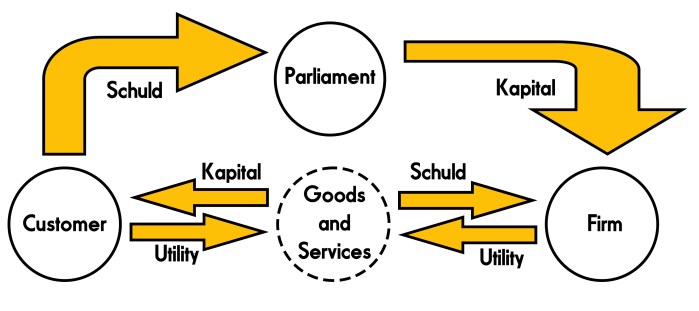
Unlike Production for Dasein, mainstream Neoclassical Economics has shoehorned most forms of political-economic governance into either Production for Profit or Production for Utility. Conventional perceptions of Liberal Capitalism and Socialism are still framed this way. Market/Mixed Economies emphasize Production for Profit vis-à-vis the Profit Motive and Kapital Accumulation. Historical and existing Planned/Command Economies emphasize Production for Utility for two reasons. The first factor is the attempt to avoid Kapital being the overriding purpose of economic life. The other–and this is where the pressures of market reforms appear–is the tendency to perceive everything based on their Use-Value with a skewed Exchange-Value.
Granted, Ludwig von Mises and Friedrich von Hayek understood the significance of Use-Value and Exchange-Value in their “Economic Calculation Problem,” but so did Jünger and Martin Heidegger in an entirely different, albeit intimately related, question altogether. The latter is only possible because of Heidegger and von Mises’ philosophies basing their own logic and ideas on the phenomenological philosophy of Edmund Husserl, which focused on the study of human perceptions, expectations and experiences. The real distinction was that von Mises and von Hayek relied on Praxeology within their Economic Calculation Debate. Heidegger and Jünger employed Psychology in their analysis of economic life as they never defined Total Mobilization with terms like Profit and Utility, regardless of wartime and peacetime conditions.
If the State of Total Mobilization is not defined by Profit or Utility, and the VCS Economy does not rely on Kapital but a Currency pegged to Arbeit, why would the Work-Standard sidestep the Economic Calculation Problem with a more appropriate equivalent called the “Political Organization Problem?” How is that possible under the Work-Standard? And why would the Reciprocal Theory of Value (RTV) and the Work Theory of Money (WTM) even permit it?
Simply put, RTV and WTM both reject Use-Value and Exchange-Value. From Aristotle and Adam Smith to Karl Marx and von Hayek, it is often assumed that the Use-Value is a given. After all, people are going to buy certain goods and services over others. Whereas Marx deviated from the conventional wisdom was to only cast doubt on the Exchange-Value, he never rejected the Use-Value because it was deliberately assumed to be a given. Marx argued that the Kapital within Exchange-Value undermined the social relations of production for the Proletariat, creating the conditions conducive to the “Alienation of the Worker.” He was convinced that if Kapital disappeared from economic life under Socialism, everything could be conducted on the basis of calculating vast quantities of goods and services and judging them as either ‘useful’ or ‘useless’.
But this sort of logic yields the same problems as the US Taxation System, which the Work-Standard deems as redundant and haphazard from the standpoint of Alexander Hamilton and his Federalist Papers on Taxation. The choice between “to give Pain and receive Pleasure” and “to give Pleasure and receive Pain” remains constant, except it no longer involves IRS Income Tax Brackets. Instead, it resembles more like the Soviet Gosplan setting production targets and quotas within the framework of a Five-Year Plan, resetting production figures higher and higher without bothering to figure out what is happening downstairs. Everyone gives to everyone else the Pain of creating advertisements for products that neither exists nor anyone wants, receiving the Pleasure of visiting a supermarket to find all the shelves bare and the unwanted goods untouched. Everyone receives from everyone else the Pleasure that comes with the opening of a McDonald’s at Pushkin Square in Moscow, giving back the Pain of waiting in the long line outside and having to serve all those people inside. Never mind the fact that not everyone’s orders are going to be the same.

Therein lies the real distinction which set the VCS Economy apart from the competing Planned/Command Economies not relying on the Work-Standard. Removal of Use-Value and Exchange-Value is only the first step. Something else needs to replace those two and Heidegger himself already elaborated the details in the pages of Being and Time. Rather than a Use-Value, there is a “Presence-at-Hand.” And instead of an Exchange-Value, there is a “Readiness/Unreadiness-to-Hand.” The differences may be subtle at first, but they will be obvious upon further examination.
Diamond-Water Paradox Revisited
Let’s recall the Diamond-Water Paradox of Adam Smith from the context of the Work-Standard. The LER Process has Arbeit affecting the Value of Diamonds and Geld affecting the Price for those Diamonds. Where there was once a Use-Value, there is now a “Presence-at-Hand”: people are coming up with theories, facts, opinions, and speculations about the Value of the Diamonds and in turn the Price for those Diamonds. But as Immanuel Kant maintained, there is no way for anyone to know what Diamonds are as a thing in themselves, as a ding an sich. Everyone only knows the outward appearances but never their real essence.
This is discernible when someone realizes that Diamonds are being needed by industries manufacturing the blades of chainsaws and the semiconductors installed into everyday electronics. Nobody in the 18th or 19th centuries was judging the Value of Diamonds on those considerations nor was anyone else in the 20th century envisaging something as small as a semiconductor. In this century, however, Diamonds are valued for the semiconductors are needed to play a video game on a gaming console or calculate the parking distance of an automobile to the nearest object. A shortage in Diamond-based semiconductors, as was the case in the Coronavirus Pandemic, is going to drive up the Price of Diamonds because everyone recognizes the functions of their effects (in the Socialist sense) or the sheer magnitude of their own existence (in the Liberal Capitalist sense).
And where there were Liberal Capitalist and Marxist interpretations of Exchange-Value, there is now “Readiness/Unreadiness-to-Hand.” Readiness/Unreadiness-to-Hand is discernible in Work-Productivity (WP), which is related to the production process and transactional sales of a particular Vocation, Profession or Enterprise. Readiness-to-Hand occurs whenever the Vocation, Profession or Enterprise is fulfilling its Legal Duties with the Legal Rights related to its economic activities, achieving a WP value that surpasses its corresponding Work-Intensity (WI) through a combination of Force Multipliers (FMs) and the Mechanization Rate (MR).
Everyone is focused on their Arbeit by trying to harvest and refine the Diamonds needed to manufacture chainsaws and semiconductors, the latter intended for the production of video game consoles and automobiles. Everyone else is transporting the chainsaws, video game consoles and automobiles to the places where they are sold, somebody buys them, and the State receives the Geld to repeat the cycle. Meanwhile, the Central Bank is adjusting the Total Economic Potential (TEP) and Total Financial Potential (TFP), the State Banks accepting the depositing of Arbeit and the withdrawing of Geld at the end of each workweek.
If everybody values the Quality of their Arbeit, they will value the Quality of their Geld. If everybody values the Quality of their Geld, there really is no point for people to form labor unions, start labor strikes and demand even more Geld for their Arbeit or others running for the banks under Socialism. If nobody is suffering from Burnout by dying of heart failure, committing suicide, abandoning their Vocation, torching and bombing the workspace, or engaging in violent and self-destructive behavior, then the Attrition/Inaction Rate remains within normal boundaries. If everybody is reporting to their Vocations daily and finding a higher sense of fulfilling a Legal Duty that satisfies their overall purpose for existing in Life, then the Attrition/Inaction Rate is minimal. And if all of this remains constant within the LER Process, then “Economic Socialization (ES)” and a corresponding “Solidarity Rate (SR)” will ensure that everyone will find their Authentic Dasein. They have realized their Authentic Dasein within economic life as a Being-in-the-World by Being-with-their-Vocation and they are going to continue with their Vocation for much of their adulthood.
This sort of economic life does not exist in any of the known Liberal Capitalist or Socialist economies. Even if there are discernible signs here and there among both types, neither will fully bring those manifestations into physical existence as governmental policies. It is an economy defined by Production for Dasein, where Authentic Dasein is the decisive factor within Total Mobilization. That economy is a Vocational Civil Service (VCS) Economy supported by the Work-Standard and sustained by a “Reciprocal-Reserve Banking System.” Truly, the Political Organization Problem is just that–‘the Total Mobilization of Production for Dasein’, the “Dasein Motive” compelling the Council State itself to embody the State of Total Mobilization.
The Dasein Motive
To summarize everything discussed so far, it is important to realize that the Dasein Motive replaces the Profit Motive by focusing more on the Quality of Arbeit as opposed to the Quantity of Kapital within the economic activities of a Vocation, Profession or Enterprise. Instead of an Exchange-Value and a Use-Value backed by the Incentives of Supply and Demand, there is a Readiness/Unreadiness-to-Hand and a Presence-at-Hand backed by the Intents of Command and Obedience. Given these concepts related to the Reciprocal Theory of Value (RTV), it becomes inevitable to envisage Surplus Value being replaced with “Meaningful/Meaningless Work” and Socially-Necessary Labor Time with the “Transvaluation of all Arbeit” that is determined by the State Commissariats of Wages and Prices.
We encounter these peculiar characteristics of Production for Dasein in the Work-Standard’s replacements of the “Commodity” and the “Market,” the “Equipmentality” and the “Tournament” respectively. Through the Intents of Command and Obedience, we can ascertain the Value of an Equipmentality such as those aforementioned Diamonds by means of its “Reference” (Command), its “Relevance” (Obedience), and its potentiality for “Repurpose” (Intent). The National Culture provides us with the preconceived References on what can be done with the Diamonds, thereby instilling a preconceived notion of its Value. The Diamond’s Value changes based on its Relevance to the production processes of different Vocations and the possibility for the Diamonds to be “Repurposed” within other production processes.
Through the Reference, Relevance and Repurpose of an Equipmentality, it becomes inevitable to determine the Price of Diamonds as an Equipmentality by means of the Work Theory of Money. Diamond Prices in the Tournaments can be altered according to the Quality of Arbeit and the Frequency at which the Diamonds are being purchased by the Totality and Foreigners. The greater the Frequency, the lower the Quality of Arbeit and more expensive the Diamonds are projected to become at the Tournaments. The extent to which the Frequency would affect the Quality of Arbeit is also influenced by the Reference, Relevance, and Repurpose of the Diamonds.
We will explore these concepts related to RTV and WTM in this Section as well as in a later Treatise. For now, always remember that the Work-Standard relies on its own methodology to ascertain the Value and Prices of Equipmentalities as well as Arbeit and Geld. In a currency system where everything is backed by Arbeit, it becomes tenable to envisage a different Mode of Production that supersedes both Production for Profit and Production for Utility, which cannot be envisaged without the conceptual models of RTV and WTM.
Categories: Compendium
 The Fourth Estate
Leave a comment