
What shall be the Work-Standard’s Theory of Money to complement RTV? The whole premise of RTV rests squarely on the LER Process, particularly the notion of committing Life-Energy into Vocations to create Actual Arbeit and contribute them to the Life-Energy Reserve of the Central Bank, where it is then converted into Actual Geld. As stated in the previous Entry, the Work-Standard’s Theory of Money shall not be based on any known Theory of Money. The other Theories of Money were derived from aspects of Bimetallism and Chartalism. Neither Bimetallism nor Chartalism are suitable for the Work-Standard. Ascertaining a Theory of Money for the Work-Standard is dependent on understanding the properties of Arbeit and how that in turn gave Geld its intended purpose as a Sociable Currency.
The concept of Geld under the Work-Standard is not affected by the sheer magnitude of its own mere existence. Thus, the Quantity Theory of Money and all other Theories of Money influenced by the quantity of Kapital in existence are not applicable to the Work-Standard. This is not the question of whether there is a lot of Geld or very little Geld in existence because such notions are not its defining characteristic. There may be moments where there could be lots of Geld and very little Geld available, but never because of Geld per se. Geld derives its Price from the effects of its intended functions according to the force and mass of Arbeit. The more Arbeit amassed and the greater its overall impact on the economy, the more Geld will be made available to allow for changes in overall economic conditions. These descriptions fit the definition of a “Quality of Geld (QM)” to correspond with RTV’s Quality of Arbeit (QW). Given what was already written about Arbeit and Geld in the preceding Entries of Sections One and Two, the relationship between QW and QM in the LER Process deserves to be defined as “the greatest Quality of Arbeit for the least Quality of Geld.”

The Synchronization of Arbeit and Geld sets the precedent for QW determining the Value of Actual Arbeit and QM affecting the Price of Actual Geld. The overall performance and well-being of everyone in their Vocations, Professions, Enterprises, Industries and Economic Sectors affect the Quality of Arbeit in relation to the Quality of Geld. The inflows of Actual Arbeit inside the Life-Energy Reserve are decisive in the discernible “Schwerpunkt (Focal Point)” of a “Work-World” overseeing conversions to Actual Geld. The QW of one Vocation is added to the Socialist Nation’s “Final Quality of Arbeit (FQW),” allowing its FQW to be combined with “Economic Socialization (ES)” and “Solidarity Rate (SR)” to yield a “Final Quality of Geld (FQM).”
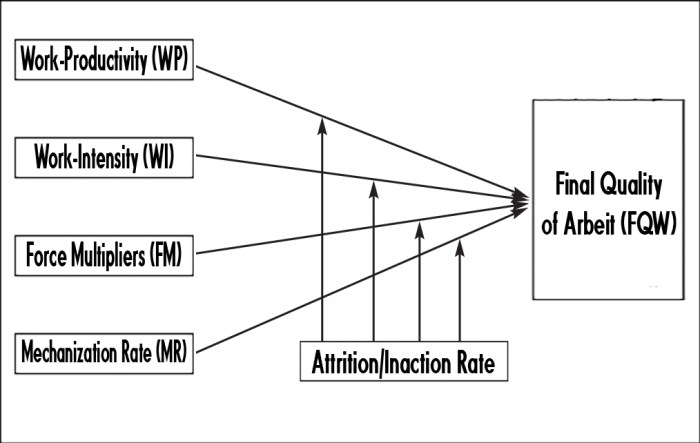

Through FQW and FQM, the Socialist Nation’s acquires its “Total Economic Potential (TEP)” and “Total Financial Potential (TFP)” respectively. The Attrition/Inaction Rate transmutes the Socialist Nation’s TEP into “Real Total Economic Potential (RTEP)” and TFP into “Real Total Financial Potential (RTFP).” Both RTEP and RTFP eventually form the Socialist Nation’s “Total Productive Potential (TPP)” as the controlling factor in the Central Bank’s ability to expand or contract the overall “Requisitionary Productive Forces (RPF).”
All of these new variables are integral to arguing why the Work-Standard’s Theory of Money happens to be related to the second half of the LER Process. This “Work Theory of Money (WTM)” stipulates that the Price of Geld is influenced by the Value of Arbeit insofar as the very notion of a Socialist Finance will always be subordinate to the Sustainability, Quality and Frequency of the entire production process. Any changes in the Prices of goods and services are caused by changes to their Quality and Frequency in relation to Sustainability, which in turn can be traced back to the RTV’s relationship to Work-Productivity (WP), Work-Intensity (WI), Force Multipliers (FMs) and Mechanization Rate (MR).
A concept such as WTM is self-evident throughout various aspects of RTV and how it oversees the contributions of Arbeit and its conversions into Geld. It becomes even more apparent when one stops to consider the idea of converting Geld back to Arbeit as part of the LER Process. Such a topic deserves to be investigated in greater detail within wartime and financial contexts, besides their usual interactions within the fiscal and monetary policies of the State. The implications suggest that the LER Process is capable of facilitating a convertibility rate which cannot be set unilaterally by any Profession, Enterprise, Industry, or Economic Sector. Instead, the Council State, specifically the State Commissariats of Wages and Prices, sets the convertibility rates for Arbeit-into-Geld and Geld-into-Arbeit, with RTV and WTM serving as the conceptual frameworks for the LER Process and by extension the rest of the Work-Standard itself. The possibility is there for the Financial Regime to devalue and revalue the Sociable Currency as needed at the behest of the Totality.
Categories: Compendium
 The Fourth Estate
Leave a comment