

The Work-Standard (3rd Ed.) was written for a very broad audience of people who share the same opposition to Neoliberalism and its world order, the Empire of Liberty. Conservatives, Socialists and Nationalists, Ultramontanes and Statists, Corporatists and Syndicalists, Environmentalists and Traditionalists, Anarchists and Authoritarians, and even sympathetic Marxist-Leninists were the intended audience. It made sense to make The Work-Standard and its related works to have a broad audience for the same reasons that the old Federalist Party was also broad and diverse in terms of its membership. But there was one audience in particular that deserve mention and those are the “State Capitalists” and “Social Capitalists.”
Everyone who read The Work-Standard knows that State Capitalism is supposed to be a temporary phase. Either Neoliberalism manages to reassert itself for the Empire of Liberty or the opposition succeeds in establishing another political-economic paradigm. Whether the opposition happens to bring two or more nations into its dominion is not the topic of what will no doubt be a four-part series of posts. Until that happens, there will always be these State Capitalists and Social Capitalists who, for one reason or another, were willing to align themselves against Neoliberalism and the Empire of Liberty. Their roles will no doubt be pivotal until the time comes for the Nation to choose between Syndicalism, Corporatism and Socialism as part of a functioning Council Democracy.
In their most fundamental forms, both State Capitalism and Social Capitalism essentially revolve around the redirecting of economic and financial firepower toward more beneficial ends. They differ from the sort of frivolous, senseless spending so characteristic of Liberal Capitalism, where a Parliament presides over Fractional-Reserve Banking Systems, Financial Markets, Labor and Real Estate Markets, and Free Trade Agreements. Here, the concept of “Welfare” cannot and will not be used as a justification to avoid recognizing the true Value of their Arbeit. That is because the Liberal Capitalists remain adamant that an expanded “Welfare Capitalism” can still be a plausible excuse for underpaying people.
The difference in priorities between Liberal Capitalists and other varieties of Capitalism should never be underestimated nor misunderstood. It is already a well-known fact that Liberal Capitalists view other Capitalists as ideological enemies for political, economic, or financial reasons. Unlike Social-Democracy and more like Feminism, State Capitalists and Social Capitalists are not easily susceptible to subversion by Neoliberalism as long as they are being backed by somebody else. Why is that the case?
In essence, State Capitalism has to be focused and driven in order to achieve its desired results. The bulk of economic and financial firepower is going to be redirected to economic activities that benefit the many as opposed to the few. It becomes inevitable to speak of the Common Good coming first before Self-Interest. One does not need to be a Pan-Germanic Socialist, let alone a Roman Catholic, to understand the meaning of the slogan, “Common Good before Self-Interest.” Although the State Capitalist and the Social Capitalist tend to support each other, it is also where they ultimately differ that we find their distinctions from the Liberal Capitalists.
The State Capitalist justifies their actions by arguing that economic life should serve the Nation before the Individual. Rather than play along with the Liberal Capitalists and their Technocrat henchmen, the State Capitalist generally prefer economic activities that require a lot of manpower and therefore have the potential to create lots of Arbeit at high Quality. For instance, Manufacturing over Fractional-Reserve Banking, Autarky over Free Trade. Everything for the State Capitalist is dependent on whether their State is capable to ensuring the prosperity of the Nation.
The Social Capitalist is motivated by a parallel belief shared by the State Capitalist, except they are more concerned about those who might get left behind as a result of State Capitalism. They believe that a prosperous Nation should consist of people who were able to grow up in places where there were ample opportunities for self-development and sense of belonging in the State of Total Mobilization. Not just the people who were never able to subsist on a decent livelihood, but also the people who would always be ostracized and outcasted by Neoliberalism. Two examples are the clergy, insofar as they are represented by long-established institutions like the Catholic Church, and the old aristocracy, like the European nobility, were sidestepped by Neoliberalism due to their apparent inability to create Kapital. They tend to view the State Capitalist and the Social Capitalist in friendlier terms because they cannot tell for certain if Syndicalism, Corporatism or Socialism will be any better than Neoliberalism.
To boil everything down to the simplest terms, I am talking about two kinds of people who feel disillusioned with Liberal Capitalism, but not quite ready or not too convinced about abandoning the “Capitalism” part. At the same time, the rest of The Work-Standard’s audience are still living under Liberal Capitalist Parliamentary Democratic regimes with no chances of attaining political power on their own. Guided by the principle of Democratic Centralism, we can have as many ideological debates as we could possibly want under Council Democracy, but none of that is ever going to happen under Parliamentary Democracy.
For the purposes of remaining politically active and not being overworked, it always helps to gain the sympathy of the State Capitalists and Social Capitalists. Here in America, one can start by evaluating the following chart depicting State Minimum Wages at the beginning of 2024 (or a few months into FY 2023-2024):
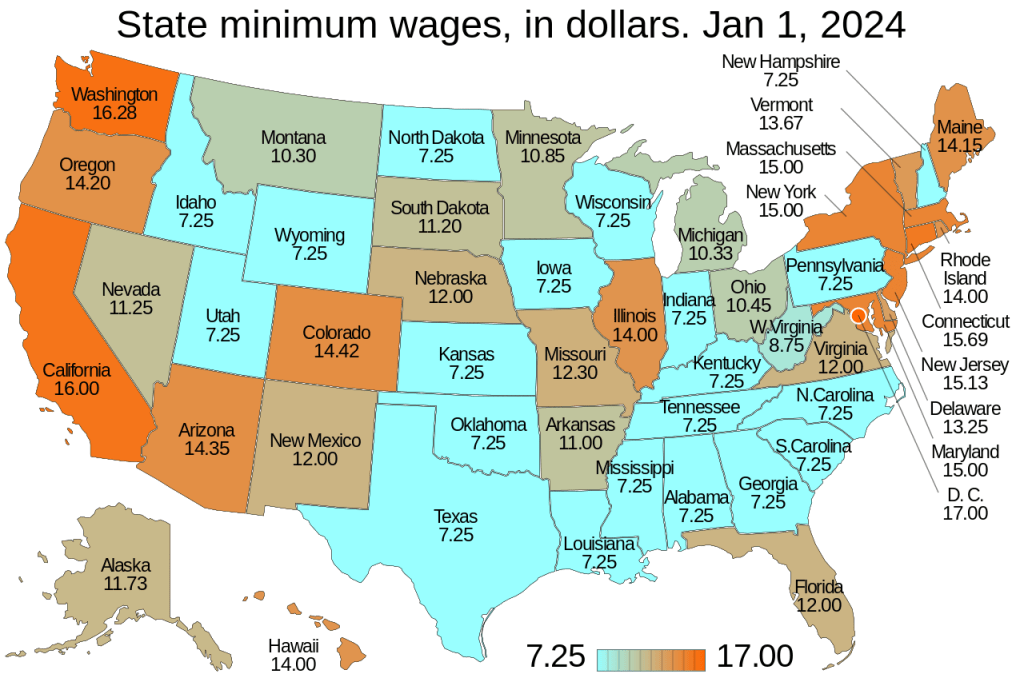
In January 2024, more than half of the State Governments within the Union had decided to increase their State Minimum Wages to some amount higher than the Federal one at $7.25. Although the Federal Minimum Wage is established and maintained by Congress at the Federal Government, that should not stop State Governments from going beyond the stipulated amount.

Recently, the Commonwealth of Virginia decided to increase its State Minimum Wage from $12.00 to $13.50 by 2025 and $15.00 by 2026. Around the same timeframe, Walmart decided to do a 3-for-1 split for the purchases of allowing even part-time employees to invest in their Stocks. What is the significance of these findings?
For our State Capitalist or Social Capitalist, these are positive developments. It demonstrates that enough pressure can be applied to achieve desired changes, however small and incremental they may be. As for the rest of the audience, assuming they happen to live in any of the US States where the Minimum Wage is higher than $7.25, that excess Kapital should be invested back into the US economy. Assuming somebody is working 32 hours for $15 per hour, a few hundred US Dollars should be invested in the US economy. If $4,800 was invested over the course of a single year, that same amount needs to be transmuted into $48,000 and eventually $480,000 over the course of a years, if not a few decades.
The rest of The Work-Standard’s audience will need to play it smart if they are going to gain the support of the State Capitalist and the Social Capitalist. Better to be surrounded by would-be friends than by would-be enemies. This means figuring out what is highly needed by most everyday people, what can be avoided, and what can be trusted to provided consistent returns for investment. More importantly, ways of setting Kapital aside in special accounts for political actions. Over the course of the next three parts, I will be describing my ongoing experiences with the Financial Markets, how I am managing my own finances, and what compelled me to do what was previously considered unthinkable more than a year ago. I might even be encouraged to share a few places that I had found to be safe places to store Kapital.
Categories: Blog Post
 The Fourth Estate
Leave a comment